My short answer is this: first decide what you want to do without glasses, and whether a monofocal lens fits that aim. Then compare models. Even a very good lens can give you a different experience from the one you expected if you and your surgeon understood the goal differently.
“Reading glasses are fine.” What about computer glasses?
A standard monofocal lens has one main distance of clearest focus. If both eyes are targeted for distance, closer tasks usually need glasses. Here is the part that is easy to miss: that may include your monitor, not just a book. Royal Free London explicitly includes computer work in its patient information.
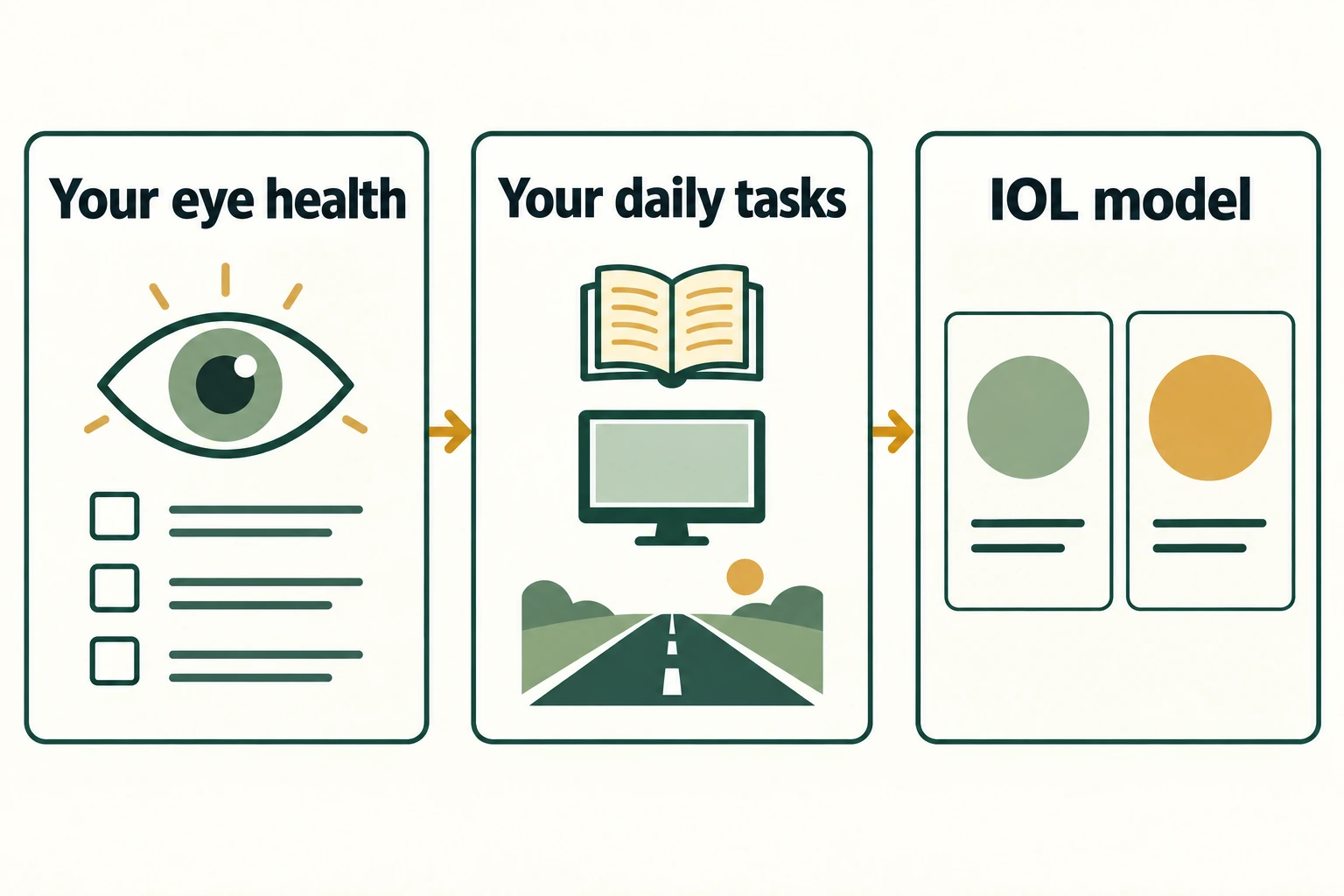
Think about an ordinary morning. You look out of the window, check a message on your phone and sit down at your computer. To you, that is one familiar sequence. To your eyes, those are different distances.
When you were young, your natural lens changed shape to help you focus closer. This is accommodation—the eye’s natural refocusing mechanism. A standard monofocal IOL does not restore it. IOL simply means the artificial lens placed inside your eye.
So “Are you willing to wear glasses?” is too broad a question. Try this instead: “Glasses for a book are fine. Would glasses throughout my working day at a monitor be fine too?”
If the answer is yes, that is a perfectly understandable plan. If not, discuss other possibilities rather than just a more expensive model in the same class.
What I would check before comparing names
First, whether the eye itself places limits on the choice. The lens is only part of the visual system. The cornea, retina and optic nerve can affect the outcome and the choice of optics. That is why an examination comes before a model recommendation, rather than being a formality afterwards. This is consistent with the ESCRS recommendations on preoperative assessment.
Second, the planned focus of each eye. Monofocal does not automatically mean distance vision. A closer focus can also be planned. The same model used with different calculations can mean different everyday possibilities. The companion article on choosing your focus target explains that decision.
Third, whether astigmatism needs correcting. When the eye’s optics bend light differently in different directions, the image can be blurred even at the intended distance. A toric IOL is one way of addressing this. But “toric” does not mean “clear at every distance”: it corrects a different optical problem. Read more about astigmatism and toric lenses.
What if you could get a little more vision without glasses?
This is where it is worth asking about enhanced monofocal lenses. Their aim is more useful intermediate vision than a standard monofocal provides. But “monofocal plus” on the label does not prove that all these models perform alike.
For me, TECNIS Eyhance is an important reference when comparing proposed monofocal options, if better intermediate vision is the aim. That view does not come from an advertising image.
In a study that randomly assigned patients to Eyhance ICB00 or standard TECNIS ZCB00, Eyhance patients could distinguish smaller letters at an intermediate distance after six months: better visual acuity. Distance vision, contrast sensitivity and unwanted light effects were similar. In plain language, better vision closer up was not accompanied by a detected worsening of those measures. That is a specific comparison, not a guarantee for everyone. Auffarth and colleagues.
What to know about the evidence
A 2025 review of 31 studies also supported an intermediate-vision advantage for Eyhance. Findings on contrast and some light effects were less dependable than those on visual acuity. We can state the advantage plainly without changing it into “all other outcomes are guaranteed identical.” The review received a Johnson & Johnson research grant; its authors reported that the sponsor did not direct the work. Publication in Eye.
And remember: extra ability closer up does not mean you will no longer need glasses for sustained reading. The Eyhance review covers that distinction. The enVista Aspire review is an example of why findings for one model should not be transferred to another just because both are described as enhanced.
What the country of manufacture will not tell you
American, German, Japanese—these describe a manufacturer’s origins, not how you will read messages or work in the evening.
Likewise, the word “aspheric,” a particular material or an attractive laboratory curve does not answer your main question on its own. Technical properties matter, but they need to be connected to an outcome that matters to you. If you want to understand why a laboratory graph is not the same thing as a person’s vision, start with how IOLs are tested in the lab.
You do not have to teach yourself injector systems, calculation formulas and every material property. You should get a clear explanation from your surgeon: why this model, what useful difference to expect in your daily life, and where glasses will remain part of the plan.
Three questions for your surgeon
- What focus are we planning for each eye, and which of my activities are likely to need glasses?
- Why does this particular model suit my eye? Does astigmatism need correcting?
- Compared with Eyhance or another available enhanced monofocal, what difference has actually been shown in patients—and would it be useful to me?
My conclusion is simple: look for a clear plan for your vision, not the loudest brand name. If glasses for particular activities suit you, good. If they do not, say so before surgery. That is much more useful than finding out afterwards that you and your surgeon meant different things by “good vision.”
To organise your priorities before an appointment, you can use the IOL questionnaire. Its result is a starting point for discussion, not a lens prescription or a substitute for an eye examination.
Watch the explanation
Monofocal lens truth - life after cataract surgery — English · April 2024.