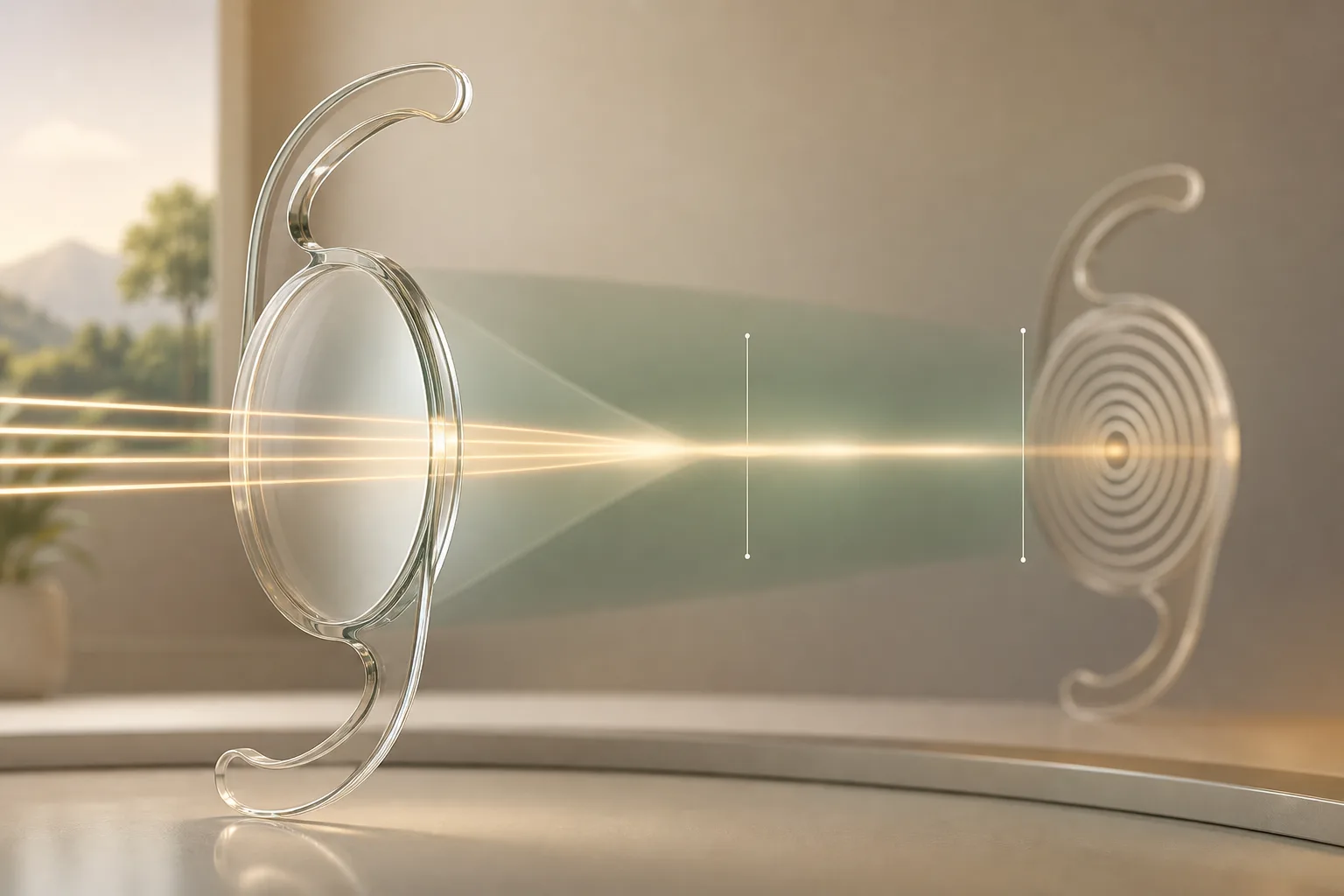
EDOF: the simple answer
An EDOF lens aims to stretch useful vision from distance into the intermediate range. It can make a monitor or dashboard easier without glasses. Fine near print often still needs readers.
EDOF is a result category, not one optical technology.
What this looks like in daily life
Imagine driving, checking the speedometer, then reading a restaurant menu in dim light. Many EDOF plans aim to cover the first two tasks better than a standard distance monofocal. The menu—especially small print—may still need glasses and good light.
Some EDOF lenses are diffractive. Some are non-diffractive and use different refractive or wavefront-shaping profiles. “Non-diffractive” tells you how a lens is designed. It does not tell you that halos are impossible or that contrast is automatically identical to a monofocal.
The trade-off
The usual exchange is more intermediate range than a monofocal, but less near than many full-range or trifocal lenses. Night symptoms and contrast may be closer to a monofocal in some model-level studies, yet they are not zero and not the same across models.
This is why I would never buy the category name. I would ask for the exact model, its test distances, and the symptom method used in its own study.
Questions for your surgeon
- Which exact model best matches my screen and reading distances?
- When will I still need glasses, and what might I notice around lights at night?
- What in my eye health could change your recommendation?
Sources: Vivity FDA approval record; Symfony FDA SSED; PureSee FDA SSED.