Not necessarily. Before surgery, you need to choose not just a lens model but the planned focus of your vision. The distinction is particularly clear with monofocal IOLs: you can plan the main focus for distance, closer up, or different distances for the two eyes. Each approach changes which activities are likely to need glasses.
This is not a choice between “successful” and “unsuccessful” surgery. It is a choice about how you want to use your vision afterwards.
What does targeting an eye for distance mean?
Before surgery, your clinician measures the eye and calculates the power of the replacement lens. That calculation aims for an agreed result. You may see it described as target refraction.
Put simply: what optical state are we trying to achieve after surgery, and where should that make it easier to see without glasses?
Do not confuse this with the model name. The same monofocal IOL comes in different powers. The calculation depends both on the eye’s measurements and on the outcome you have agreed with your surgeon. ESCRS explicitly recommends making that target decision together. Target-refraction recommendations.
The calculation does not restore accommodation—the natural refocusing of a young eye. A monofocal IOL does not change shape to focus first on a book and then on the distance.
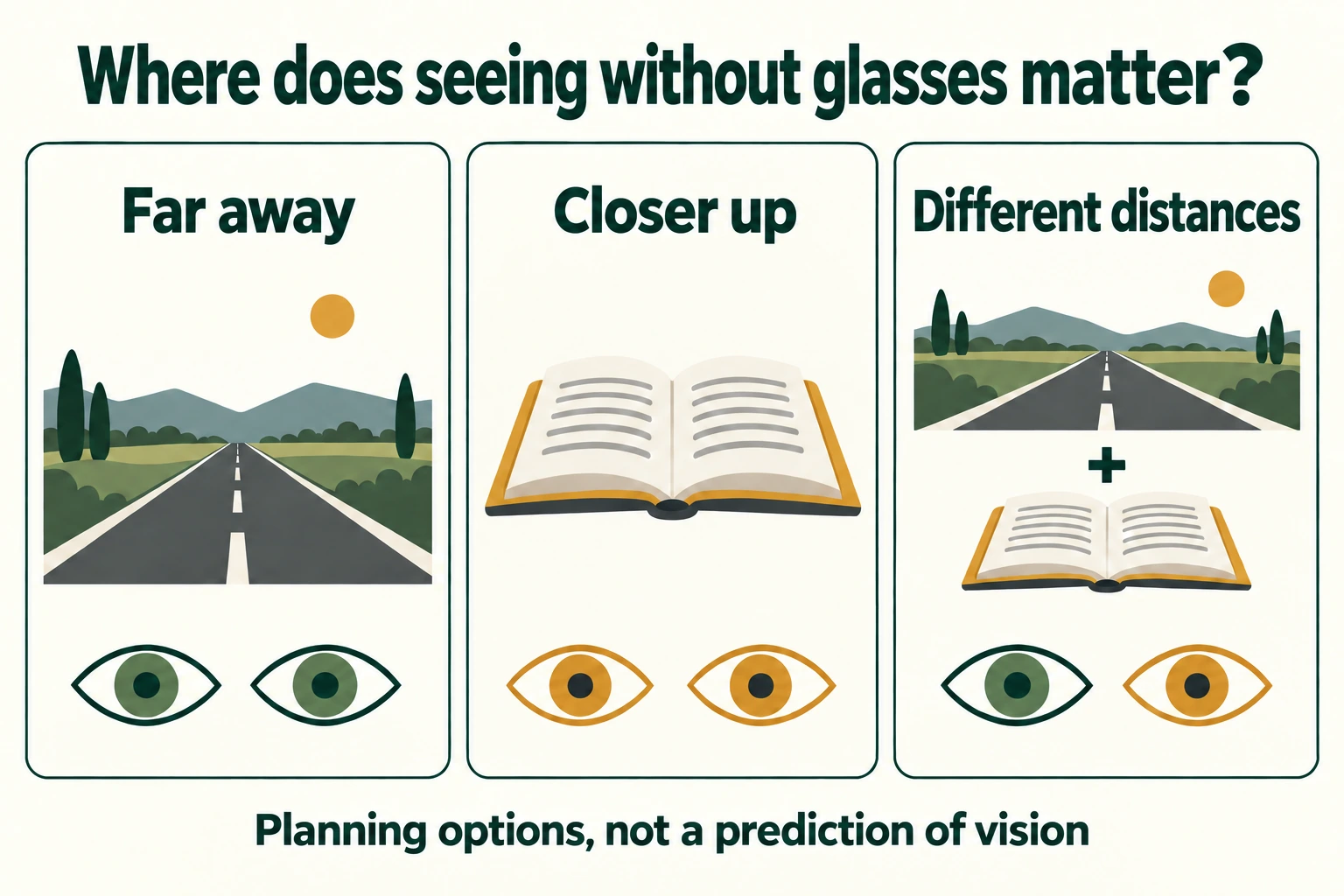
Option 1: prioritise distance vision without glasses
This is an understandable choice if you mainly want to look outdoors, recognise people farther away and use your vision beyond arm’s length without wearing glasses all the time.
With two standard monofocal lenses targeted for distance, reading and often computer work need additional correction. Glasses may still help at distance too, if a small amount of short-sightedness, long-sightedness or astigmatism remains after surgery. Royal Free London explains these possibilities.
Arguing about whether that is “good” or “bad” misses the point. Ask whether putting on glasses for the activities that occupy much of your time would suit you.
Option 2: keep closer vision as the priority
For someone who has read without glasses for years, this may be an important habit. It deserves a conversation before surgery. Not everyone wants to exchange it for distance vision without glasses.
Agreed recommendations from ophthalmologists and optometrists specifically highlight short-sighted patients: explain the option of a closer target rather than silently assuming distance is the only correct goal. This was an expert consensus exercise, not a trial proving one plan superior for everyone. Charlesworth and colleagues.
A closer focus means glasses will be needed for distance. But you still need to be specific: closer to what? The book in your hands or the monitor on your desk? Calling both tasks “reading” does not make their visual requirements identical.
Measure your habitual distances before the appointment. If the monitor is your priority, see the separate article on IOLs for computer work. Here, we are choosing the distance that matters most—not selecting a universal dioptre value from the internet.
Option 3: one eye more for distance, the other for closer work
This is called monovision. The name describes a plan: the eyes are targeted differently so that together they offer more opportunities to manage without glasses. It is not a special IOL model, and it does not mean the other eye stops working. ESCRS patient information.
It sounds appealing: one eye sees better farther away and the other closer up. But our eyes do more than read letters. They help us judge where objects are relative to one another. Precise depth perception from the two eyes working together is called stereopsis.
A difference in focus between the eyes can reduce that precision. Think of carefully bringing a tool to a small part: knowing “I can see it” is not enough; you also need to judge where it is. This is a possible limitation of monovision, not a claim that everyone loses depth perception or cannot lead an active life.
What a study shows—without turning it into a universal prescription
In a study of 35 people with monofocal IOLs, differences between the eyes were simulated using additional lenses. As the difference increased, near vision improved but stereoscopic precision decreased. That illustrates the decision well. It does not establish a single “safe” dioptre difference for all people and all lens models. Hayashi and colleagues.
You may hear “mini-monovision” or “micro-monovision.” These usually describe a smaller difference, but the prefix alone does not tell you what is planned. Ask about the actual target for each eye and the expected everyday abilities. If a small difference helps at a monitor distance, that is not automatically a promise of comfortable small-print reading closer up.
Can you understand the choice before surgery?
If you have already used monovision contact lenses comfortably, tell your surgeon. If not, ask whether a trial is possible and what it could meaningfully assess in your situation.
Do not treat any demonstration as an exact preview. Your natural lens and cataract remain present during a trial; after surgery, the optics will be different. Even a successful test cannot guarantee future comfort.
Discuss both eyes, even if only one is being operated on now. What matters is not just how the operated eye sees on its own, but how you will use both eyes together, including the interval before a second operation.
Are lenses with a broader range a different solution?
Yes. Enhanced monofocal, EDOF and full-range lenses have different optical capabilities. But choosing the design does not remove the need to agree on its planned target. “Which model?” and “What vision are we aiming for?” are connected, not identical, questions.
Editorial addition · IOL Adviser · 8 October 2026
EDOF or mini-monovision: what is the difference?
EDOF describes the lens. Mini-monovision describes how the two eyes are planned to work together. They are not two names for the same thing, and they are not always competing alternatives.
An EDOF lens is designed to extend the useful range of focus within each eye, particularly from distance towards a screen at arm's length. The abbreviation means extended depth of focus. It does not mean the lens refocuses like a young natural lens, or that every EDOF model provides comfortable small-print reading.
Mini-monovision takes a different approach: one eye is aimed more at distance and the other slightly closer. It can be planned with monofocal lenses. An EDOF lens can also be used with a small difference between the eyes. That is a combined plan, not a new category of lens.
Start with the task, not the label
Imagine your normal evening: read a message, work at the monitor, then look across the room. Being able to manage the monitor without glasses is useful. But it does not automatically mean you can comfortably read a small-print book for half an hour.
If the monitor is your priority, ask what an EDOF lens aimed at distance is expected to provide at your screen distance. Then ask whether mini-monovision with a simpler lens could meet that same need. Compare the proposed plans, not just their names.
If the priority is sustained reading, ask where glasses are still likely with either plan. The words “EDOF” and “mini” do not answer that question. The lens model, planned result for each eye and your examination all matter.

What should you compare before agreeing?
Compare three things: the activities you expect to manage without glasses, lights at night with the exact lens model, and how a difference between the eyes might affect judging distance precisely. That last issue is the stereopsis discussed above. A smaller difference is still something to discuss—not a guarantee that adaptation will be effortless.
The useful question is not “Which sounds more advanced?” It is “Which plan gives me the everyday abilities I want, with limitations I can accept?” Ask your surgeon to explain the exact lens and the intended vision for both eyes. There is no universal lens-and-focus combination to choose from a website.
Three questions before deciding
- What vision without glasses are we planning for each eye, and what will change for my familiar activities?
- If we plan different distances, how could that affect the eyes working together, and can we assess anything before surgery?
- If the result differs from the calculation, what correction options would be available and what limits would they have?
Ask for the agreed plan in plain writing. Not just the lens name and numbers, but where you are expected to see without glasses and where they will probably still be needed.
A good result starts with you and your surgeon understanding the same goal. For one person, that is distance without wearing glasses all the time. For another, it is familiar reading. What matters is that the choice is an informed decision, not a surprise after surgery.
Watch the explanation
Monofocal lens truth - life after cataract surgery — English · April 2024.
Different lenses in the two eyes: distinguish powers, focus targets and optical designs.