So can you read, or can you not?
Both descriptions can be true. Recognising the smallest text you can manage is not the same as reading easily, at a useful speed, for as long as you want. That difference matters when choosing an intraocular lens, or IOL. “You will be able to read” is an incomplete answer until we agree on what reading means to you.
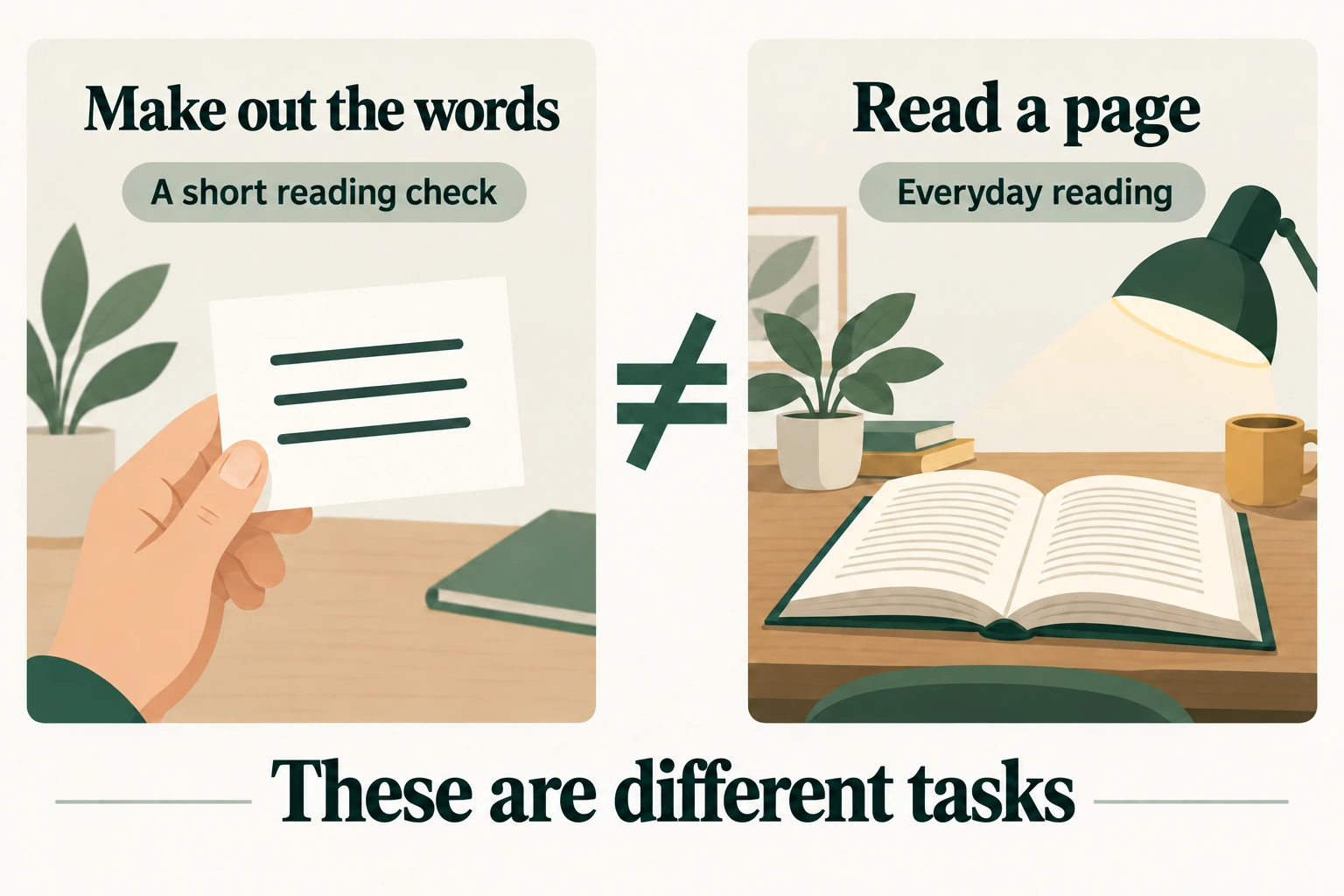
A message and a chapter are different requests
Checking a price, reading a message and spending an evening with a book all involve text. But a few seconds of effort may be acceptable for a label and irritating for a whole page.
This is the distinction I make in my explanations: “I can technically see it” tells us whether a task is possible. “I can use it comfortably” tells us much more about whether that result suits your life.
For this article, functional vision means vision that lets you carry out the task. Comfortable vision means that you can do it with a level of effort you find acceptable. These are useful everyday descriptions, not two universal medical scores or two separate IOL categories.
You can be genuinely pleased that you see better after surgery and later notice, in everyday use, that reading still takes more effort than you expected. Those feelings do not cancel each other out. That is why I separate two questions: what can you do, and how comfortable do you find doing it? If a task remains difficult, tell your surgeon—even if you were delighted at the first check.
If you read a novel every evening, tell your surgeon that. “I need to read” could otherwise mean anything from checking a receipt to working through several chapters.
Why not aim at the smallest letters you can just see?
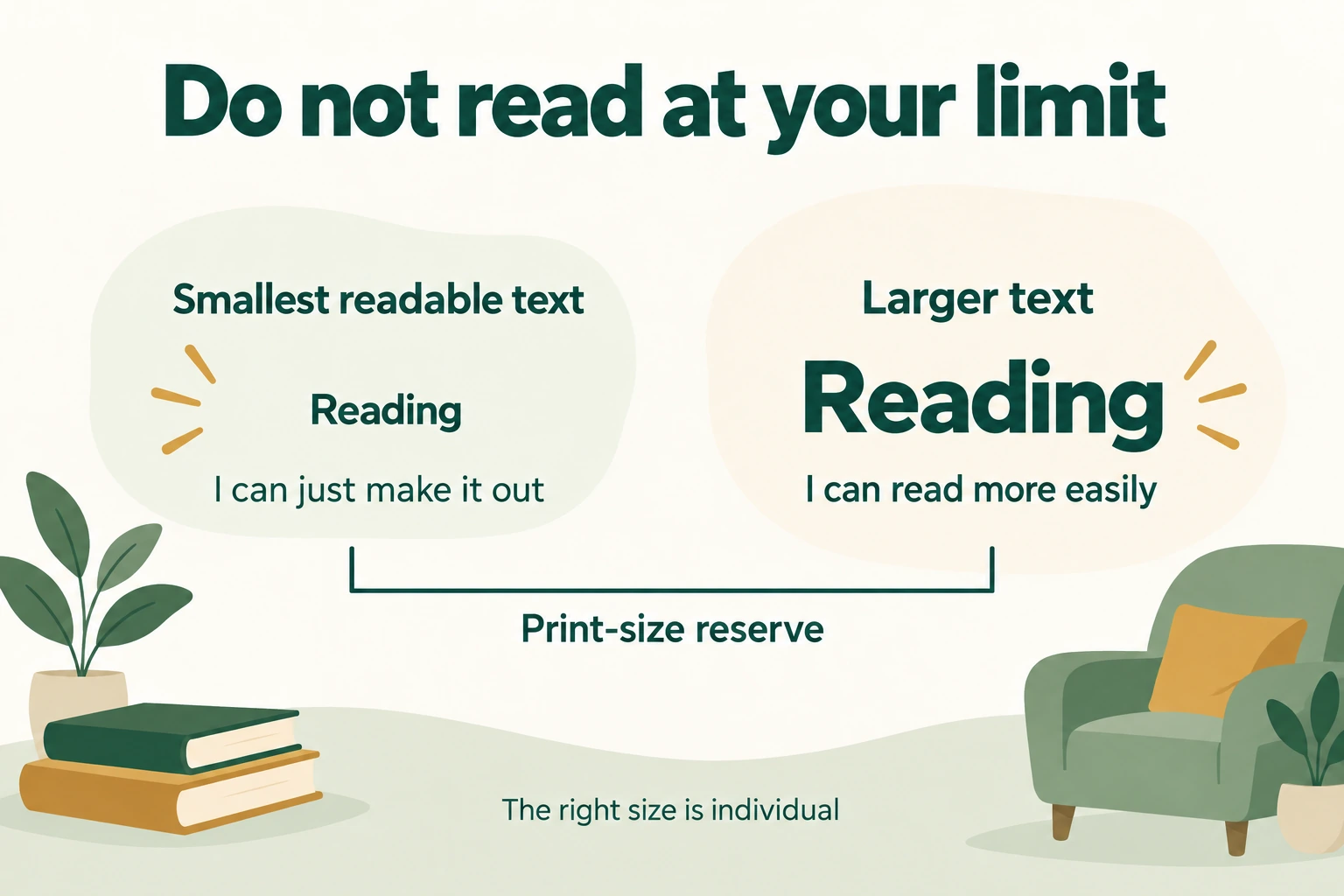
Think about increasing the text size on your phone. The smaller version may be readable if you concentrate; a larger version can let you read more freely. You have not changed the words. You have changed how close that text is to your limit.
That relationship has a name: acuity reserve. It compares the size of the text you are using with the smallest text you can recognise under comparable conditions. If the letters you are reading are three times as tall as your threshold letters, at the same distance, that is a reserve of 3:1.
In plain language: you are not asking your eyes to work with letters that are only just distinguishable. You have some room between “I can make that out” and the text you actually want to read. This is not accommodation—the focusing ability of a young natural lens—and it does not mean an IOL magnifies everything threefold.
Where do “three times larger” and “five lines” come from?
There is a research basis for these numbers. In their work on reading rehabilitation, Lovie-Kitchin and Whittaker described a reserve of 3:1 or more for maximum or near-maximum reading speed. On a standard logarithmic chart, that corresponds approximately to five lines. The same paper gives smaller reserves for less demanding reading tasks. Lovie-Kitchin and Whittaker, 1999.
The Canadian low-vision guideline makes the task distinction explicit: a twofold reserve is a common starting estimate for fluent reading, while a larger reserve may be needed for maximum speed. The required reserve depends on the reading task, as well as the reader.
Threefold reserve is a useful guide to the difference. Text for free-flowing reading often needs to be appreciably larger than text you can barely decipher. The individual size still needs checking. Much of this prescribing guidance comes from low-vision rehabilitation; it does not establish a universal postoperative target for every IOL patient.
Nor does a threefold reserve mean “reading glasses of plus three.” A ratio of letter sizes and the optical power of glasses are different things.
Can one extra line really matter?
It can. Suppose the text you normally read is close to your limit. If you can distinguish somewhat smaller letters at that same distance, your usual text is now farther above that limit. That gives a sensible reason why a modest chart improvement might matter in daily life.
In a talk for doctors, I used a simple example: seeing a pair of pliers well enough to pick them up is one thing; making out the screw head you want to work on is another. In the kitchen, seeing an onion is not the same as seeing how you are cutting it. The useful result is not just recognising the object, but seeing the detail needed for the task.
But it is not proof that every one-line improvement produces the same gain in reading speed or comfort.
On a logarithmic chart with standard 0.1 steps, adjacent letter sizes differ by a factor of about 1.26. Five steps correspond to about 3.16—hence “roughly three times.” One line is not threefold, and 26% in letter-size ratio is not 26% better vision or 26% less fatigue. MNREAD chart design.
That is why I would neither dismiss a one-line advantage nor turn it into a promise. Ask what was measured, at which distance, and whether the study also tested actual reading.
A result worth looking at beyond the smallest print
In a study of 39 people with a Symfony extended-depth-of-focus lens in one eye and a TECNIS bifocal lens in the other, researchers measured reading with both eyes together. Figure 4 shows the distinction clearly: participants could still read smaller print, while their average reading speed had already fallen. Being able to read that size did not mean they could read it as quickly.
This was an unmasked, nonrandomized study at one practice, assessed at three months and funded by a Johnson & Johnson Vision research grant. It was not an Eyhance comparison and did not measure whether people could read a novel comfortably for an hour. Sandoval and colleagues, 2020, Figure 4.
This can be tested—not just discussed
There are reading charts that measure more than the smallest line. MNREAD, for example, uses short sentences to assess the smallest readable print, maximum reading speed and the smallest print that still supports that speed. That last measure is called critical print size. “Critical” here means the point below which reading speed starts to fall, not a danger to your eyes. University of Minnesota: MNREAD.
These measures do not capture every aspect of comfort or a whole evening of reading. But they give us a more useful question than “Did you manage the last line?”
Show your surgeon your own book or phone before the operation—not instead of an examination, but to explain what you actually want to do. Describe the text size, distance, lighting and how long you usually read. Say what you can do now, with and without glasses, and where it becomes difficult.
That gives the discussion a useful starting point: after surgery, is this particular task likely to be easier, much the same or harder? Keep the comparison specific. Better distance vision alone does not tell us what reading or computer work will be like.
Size is not the only issue. Pale text can be harder to use than dark text at the same size; larger letters alone do not explain every visual complaint. I explain that separate part of vision in the article on contrast sensitivity.
What this changes about lens choice
It changes the question, not automatically the lens.
Instead of “Will I be able to read with this IOL?”, ask: “What kind of reading do you expect me to manage without glasses, and what is likely to be more comfortable with them?”
A plan that includes reading glasses can be entirely consistent with your priorities. A plan aiming for more independence from glasses also needs to be judged against your actual text and distances—not just the smallest line someone in a study could read.
I would not use acuity reserve to declare that everyone needs one particular lens. I would use it to make sure that we are discussing the result you want, rather than two different meanings of the word “reading.”
Three questions to take to your surgeon:
- Compared with what I can do now, how do you expect reading this book or phone at my usual distance to change after surgery—with and without glasses?
- Does that expectation come from a smallest-line test, a reading-speed test, or patients reporting how they use their vision?
- If I can decipher the text but do not find reading comfortable, how will you check the cause and what could help?
If reading is already difficult after surgery, do not assume acuity reserve explains the cause. Arrange an assessment. Increasing pain, redness or worsening vision after surgery needs urgent advice from your surgical team, not simply larger text. NHS postoperative advice.
My point is simple: you are not choosing a lens to demonstrate, once, that you can read a few small words. You are choosing how you want to use your vision afterwards. Those words need to lead to that conversation.
Watch the explanation
Why EDOF IOL can make you crazy and how to avoid this — my English video on IOL-adviser, December 2025.
The video introduces the difference between possible and comfortable reading. This article gives the more precise context for the threefold reserve: a useful reading-speed guide, not a fixed requirement or guarantee for every patient.