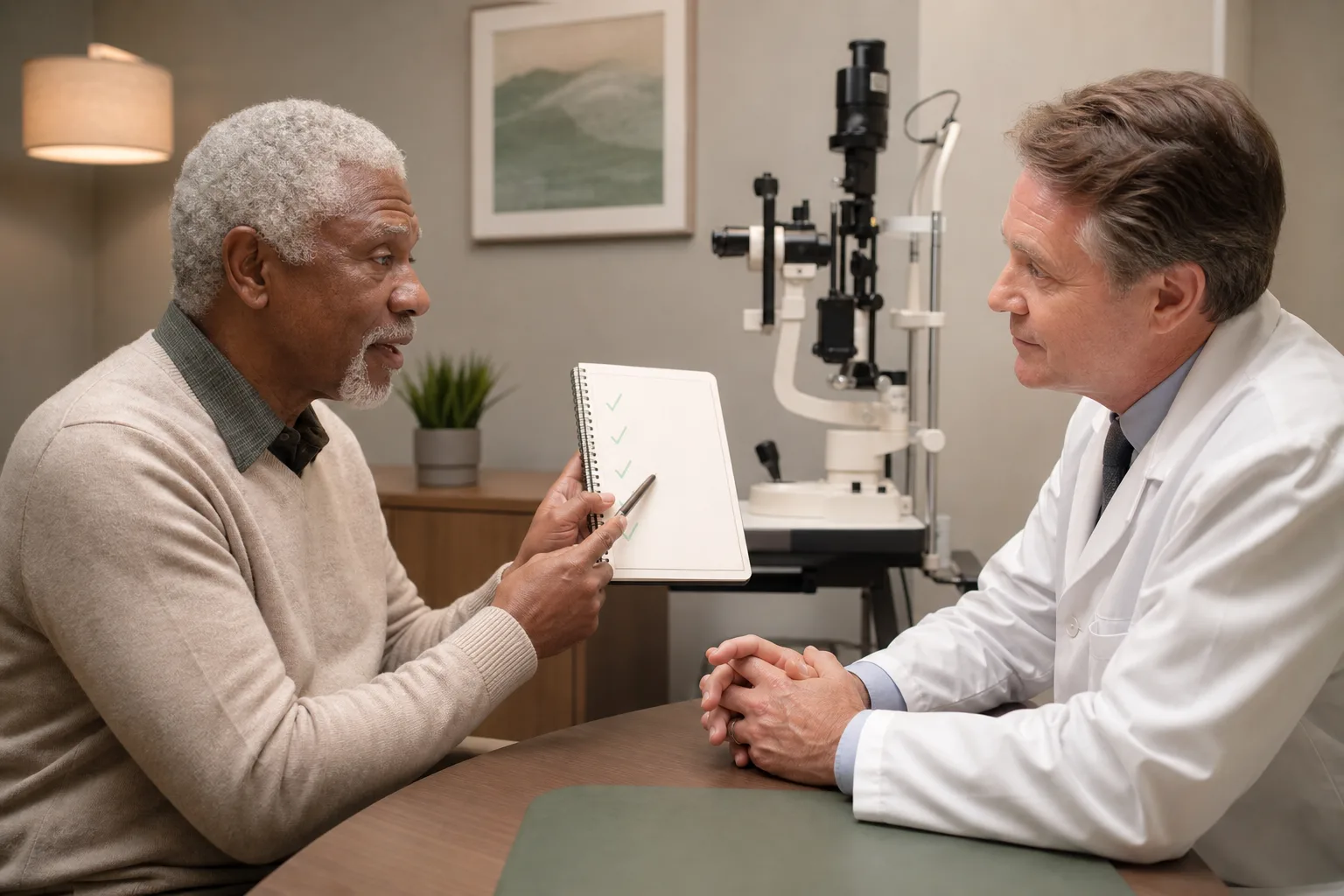
Bring your own priorities, leave with clear answers
Start with the question I ask first: for which activities do you want to avoid glasses, and where would glasses be acceptable? “I want good vision” is too broad. Reading a phone at 35 cm and driving at night are different tasks. Write yours down before discussing lens names.
You can type notes below or print a blank copy. Notes are not sent or saved by this site; they disappear when you leave or reload. Print or save as PDF to keep them.
Before the appointment
The lens and the focusing target
Which lens options are medically suitable for my eyes, and why are you proposing this particular model?
Ask for the exact model name and how it connects to your priorities. A category name such as EDOF does not describe every lens in that group.
What focusing target do you plan for each eye, and what should I see without glasses at my actual working distances?
The lens and its target work together. If the plan uses different targets in the two eyes, ask what the difference is and whether a contact-lens simulation would be useful.
What the examination changes
Do I have corneal astigmatism, is it regular, and would a toric IOL help?
Ask which part of the astigmatism the proposed toric lens can correct. An irregular cornea needs a different discussion from regular corneal astigmatism.
Do dry eye, retinal changes, glaucoma or other findings limit my options or expected result?
Ask what needs treatment or further examination before the measurements and choice can be trusted.
Does my previous eye surgery change the lens calculation or the chance of missing the target?
Mention LASIK, PRK, RK and other eye operations. Bring old records if you have them; ask what uncertainty remains even with careful measurements.
Glasses, contrast and night vision
With this model and target, when should I realistically expect to need glasses?
Name the tasks: small phone text, a book, a computer, driving. Ask whether quoted study figures mean never needing glasses or combine rarely and never.
What did this exact lens’s comparative studies show about halos, glare and dim-light contrast?
Ask which lens it was compared with and under which conditions. A laboratory optical measurement is not the same as a patient’s night-driving experience.
Experience and the reason for a recommendation
How much experience do you have with this model, and what has disappointed patients who received it?
Studies describe group results; experience helps apply those results to particular eyes and recognise practical problems. Ask how both inform the recommendation.
If you advise against an option I am interested in, what is the specific reason?
It may be eye health, the expected visual result, availability or experience with that model. Ask for the reason rather than interpreting caution as a missed opportunity.
Availability, price and the next step
Which suitable models can I actually obtain at this clinic?
Availability matters. Ask whether an alternative you have read about is offered here and who has experience implanting it.
What is the total cost, what is covered, and what would I pay separately?
Ask for an itemised estimate including the lens, tests, surgery and follow-up. Compare the concrete benefit with a well-chosen standard option, not just the price label.
If the result differs from the plan, who will review it and what follow-up is included?
Clarify who to contact and whether additional examinations or corrective treatment would involve separate costs.
Before you decide
You should be able to explain which model and targets are proposed, what you hope to gain, and where glasses or other limitations may remain. Your priorities should have been heard and the reasons for the recommendation should be clear. If something still does not make sense, ask again. A second ophthalmic opinion is reasonable when important questions remain unresolved.