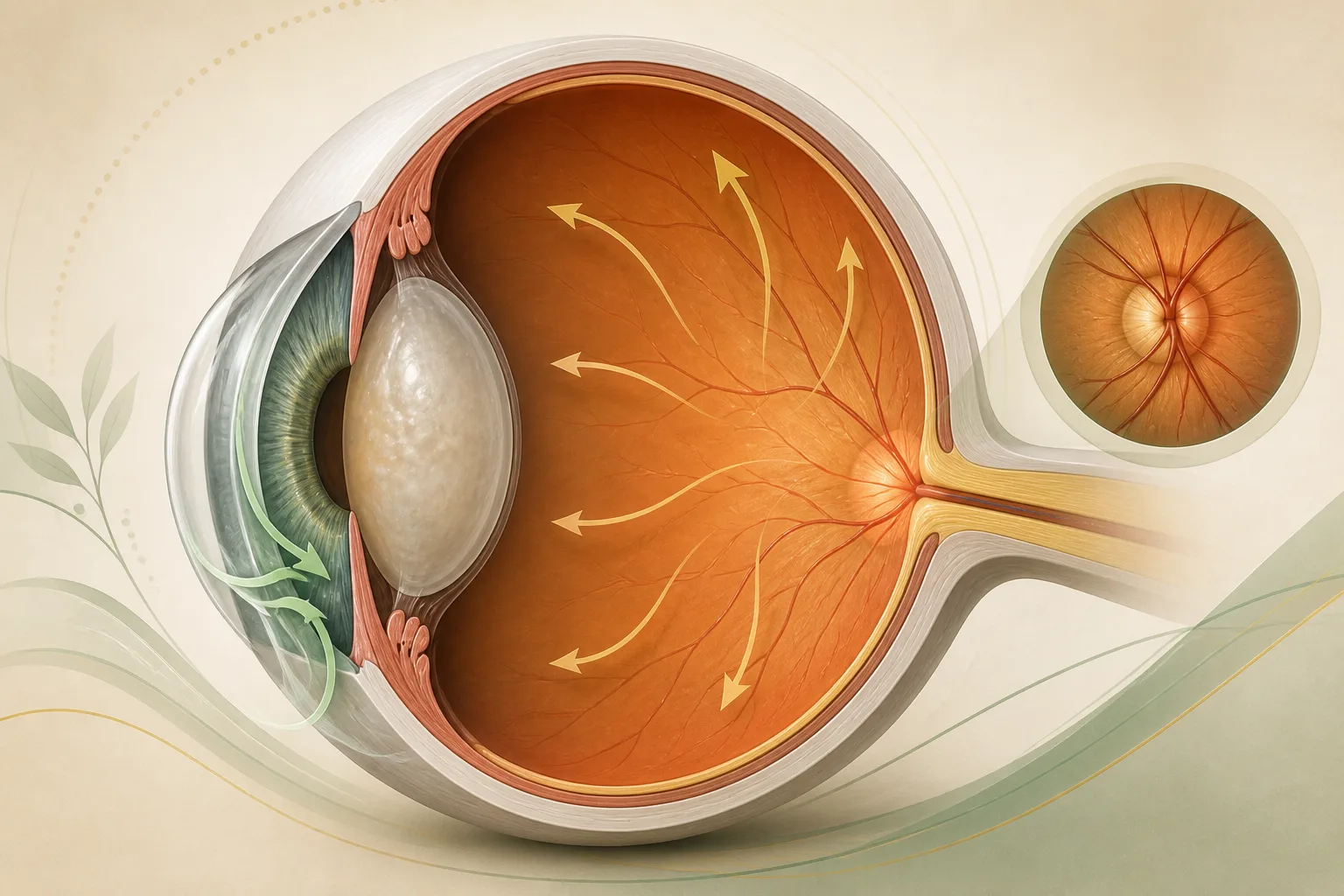
Glaucoma can be quiet—and the damage cannot be rewound
Glaucoma is damage to the optic nerve. Eye pressure is the main risk factor we can change, but glaucoma is not simply “high pressure.” A person can have nerve damage at a statistically normal pressure, or high pressure without established glaucoma.
Early open-angle glaucoma often gives no warning. You cannot rule it out with an online symptom test.
Pressure-lowering treatment can protect the nerve that remains; it cannot restore nerve fibres already lost. That is why treatment and lifelong monitoring matter even when vision still feels normal.
Why this changes the IOL discussion
A patient may still read the smallest high-contrast letters and yet lose contrast or parts of the visual field. That matters when choosing an IOL. Adding an optical trade-off to an optic nerve with limited reserve may feel very different from adding it to a healthy eye.
Glaucoma assessment checks both structure and function. The optic nerve carries visual signals to the brain; examination and scans look for damage. A visual-field test maps which areas you can notice while looking straight ahead. Pressure and corneal thickness help interpret pressure-related risk. Gonioscopy examines the drainage angle where fluid leaves the front of the eye. No single number tells the whole story.
Treatment is a sequence, not a universal ladder
Treatment aims to lower pressure enough to reduce the chance of further damage. The right sequence can include selective laser trabeculoplasty (SLT), a laser procedure intended to help fluid drain and lower pressure, as well as drops, minimally invasive glaucoma surgery, or conventional surgery. It is outdated to say that drops must always come first and surgery is only a last resort.
For appropriate newly diagnosed ocular hypertension and non-advanced open-angle glaucoma, NICE includes 360-degree SLT as a first-line option. That does not make SLT the first choice for every glaucoma type, pressure target, or health system.
Cataract surgery may lower pressure in some eyes and can be combined with a glaucoma procedure, but it is not a universal glaucoma treatment. Combined surgery can also change healing and refractive predictability.
Questions for the glaucoma and cataract team
- What type and stage do I have, is it stable, and what pressure are we aiming for?
- Should cataract surgery be done alone or with a glaucoma procedure, and how might that affect the result?
- Which IOL fits the function I need to protect, and will it affect future tests or treatment?
Sudden severe eye pain, headache, nausea, blurred vision, coloured rings around lights, or a red eye can indicate acute angle closure and needs emergency assessment.
Sources: NICE glaucoma recommendations NG81; National Eye Institute: laser treatment for glaucoma; ESCRS cataract-surgery guideline; systematic review of premium IOLs in glaucoma.
Editorial addition: IOL Adviser · 11 October 2026
I see worse and want fewer glasses: what should the lens discussion establish?

Separate the problem you want to improve
Bring concrete examples: signs are harder to read, faces are less distinct in dim light, or close work needs better lighting. Ask the team what cataract removal is reasonably expected to improve and which limitations come from glaucoma or another condition. The same complaint does not identify the same cause in every eye.
A good reading on a high-contrast chart is useful, but it is not the whole account of the tasks you need. The written plan should connect the examination with those tasks rather than simply naming a ‘premium’ package.
Why ‘early glaucoma’ is not enough to approve a trifocal
The IOL conversation should include disease stability, the pattern of field loss, central visual function and the likely future course. Age alone cannot approve or forbid an implant. A stable selected early case and progressing disease are not equivalent decisions.
Monofocal strategies generally add fewer simultaneous-focus optical compromises. Some other designs may be considered in carefully selected eyes, but a category name such as EDOF is not a blanket guarantee. Ask about the exact proposed model, why it fits your findings, and what glasses may still be needed. Do not assume that spending more repairs nerve damage.
Does a combined glaucoma procedure change the plan?
Discuss whether pressure treatment and cataract surgery will be combined, and what this means for measurements, recovery and subsequent monitoring. Our separate article covers SLT, MIGS and the wish to reduce drops. Cataract surgery and glaucoma treatment have related but different purposes.
If drops make the eyes uncomfortable, tell the team before the lens measurements. Do not stop them yourself. The ocular-surface discussion before cataract surgery is also relevant.
Turn preferences into questions, not self-selection
The visual-priorities questionnaire helps describe reading, computer and distance tasks. It cannot medically clear a trifocal, rule out glaucoma or substitute for the clinician's interpretation of fields and scans.
- Which visual functions are most important to preserve in my eye?
- Why this lens rather than a simpler optical strategy?
- How might progression or later glaucoma treatment affect its usefulness?
- What remaining glasses and follow-up should I plan for?
Evidence for this addition
Hong and colleagues: systematic review of premium IOLs in glaucoma (2023); ESCRS cataract recommendations. Checked 11 October 2026. The evidence does not justify a universal promise of spectacle independence or a rule based only on age.