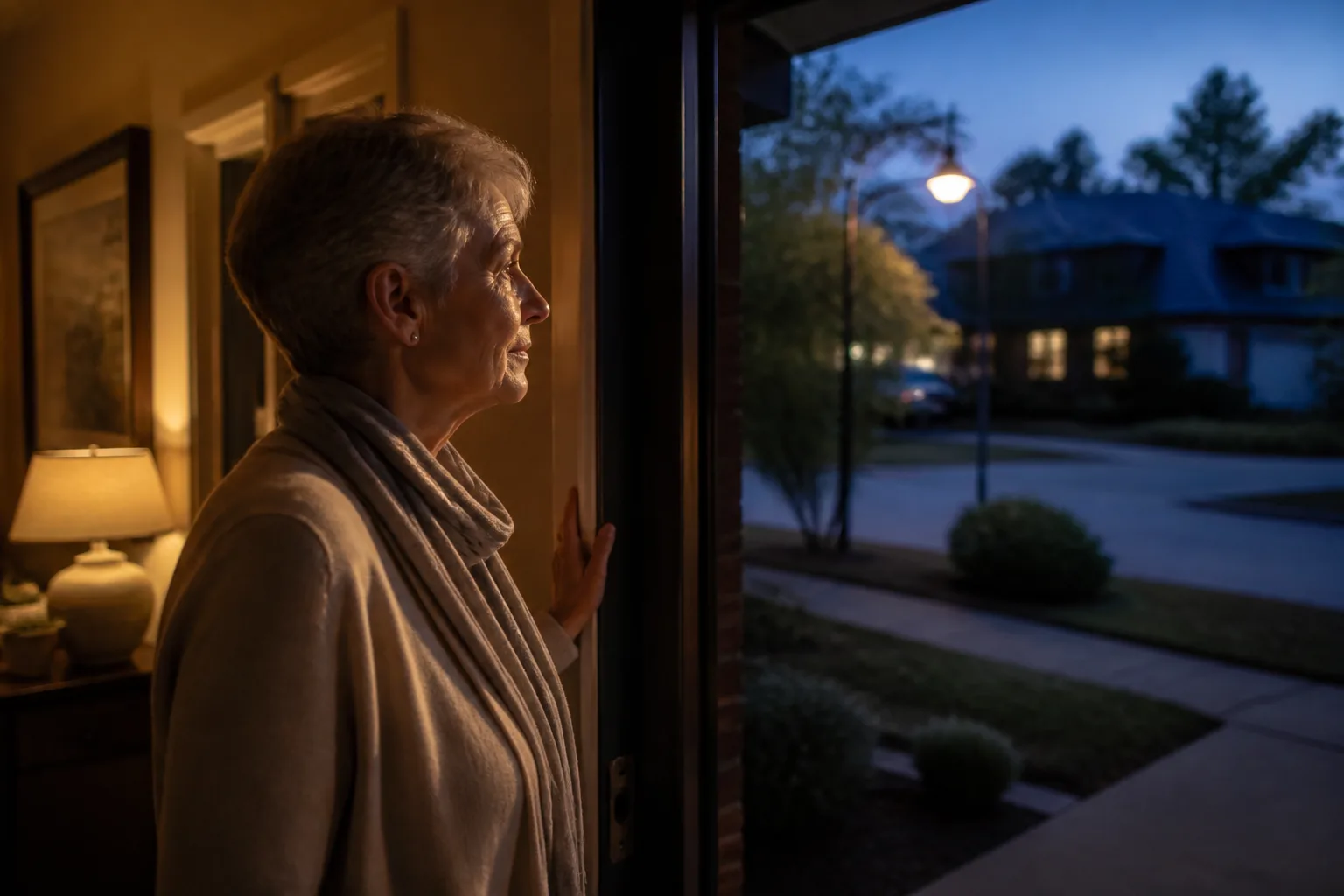
Start with the road, not the lens name
“I drive at night” can mean a ten-minute city trip once a week. It can also mean two hours every evening on wet, unlit roads. Those are not the same visual priority.
Night driving needs a clear image: a healthy cornea and retina, accurately corrected focus, and the ability to see details that barely stand out from the background. These are the practical roles of eye health, refraction and contrast sensitivity. A monofocal-style strategy is often a conservative reference. A wider-range lens may reduce glasses use, but its effect on night symptoms and contrast depends on the exact model and your eyes.
So describe the real road: rain, motorway speed, oncoming LED headlights, missing streetlights, and whether driving is your job. If that task is non-negotiable, say it before the conversation turns to reading without glasses.
Halo, glare and starburst are not three names for the same thing
A halo is a ring or glow around a light. Glare is a broader veil of brightness that washes out part of the scene. A starburst is a set of rays extending from the light source. Ophthalmology groups these extra-light effects under the term positive dysphotopsia.
Those terms matter because “night problems” is too vague for diagnosis or comparison. A ring that appeared immediately after surgery, a smeared headlight that improves when you blink, and a dark crescent at the edge of vision are different reports and can have different causes.
Why dim light exposes problems that daylight hides
At night the pupil opens wider. More peripheral cornea and more of the IOL optic enter the image. Small refractive errors, corneal irregularity, lens decentration and some optical zones can therefore matter more than they did in a bright clinic with a small pupil.
The retina is also working with less light. That makes contrast sensitivity crucial: a dark pedestrian, faded lane marking or kerb may not stand out strongly from the background. A person can read 20/20 black letters in the clinic and still struggle with that task.
Why wider-range optics can change the night image
A diffractive multifocal or trifocal lens creates more than one focal contribution from the same incoming light. I use a glass of water to explain this specific mechanism: if you divide the available water between distance, intermediate and near glasses, no single glass receives the whole amount. The lens gains range, but light is distributed differently and diffractive steps can create additional light patterns.
This model is useful for diffractive light distribution. It should not be pasted onto every EDOF or enhanced monofocal. Non-diffractive lenses shape focus in other ways, and their contrast and symptom profiles have to be read from exact-model clinical data—not guessed from the category label.
A conventional monofocal generally provides the cleanest reference at one target. That still does not guarantee perfect night vision. An inaccurate result, residual astigmatism, dry eye, the cornea, pupil, retina or optic nerve can spoil the image even when the IOL design is simple.
The percentage changes when the question changes
Night-symptom numbers are easy to misuse. A study that asks every patient, “Do you see a halo?” will usually find more events than a study that waits for someone to complain spontaneously. Awareness is also different from severity, and severity is different from being unable to drive.
Adaptation can help—but it is not a dismissal
Some people notice halos or starbursts less over weeks or months as the visual system adapts to a stable optical pattern. That is called neuroadaptation. It is real, but it is not a promise that every disturbing symptom will disappear.
Do not make “just ignore it” the first treatment plan. After surgery, glare or poor night vision can come from dry eye, residual prescription or astigmatism, an irregular cornea, posterior capsule opacity, IOL position, retinal disease or glaucoma. Those causes need an examination because some are treatable and some change the urgency.
Turn “night driving” into a decision
If the job is a dark rural road every night, a small loss of low-light reserve may matter more than occasional freedom from reading glasses. If night driving is rare and near independence is the dominant goal, the same exchange may be acceptable.
There is no universal winner hidden in that paragraph. There is, however, a more honest comparison: exact lens, exact symptom method, exact contrast condition and exact road you need to drive.
If night driving is the priority, compare these exact outcomes
- Bothersome halo, glare and starburst—not merely whether someone noticed them.
- Contrast sensitivity in dim light, not only high-contrast 20/20 acuity.
- Residual prescription and the astigmatism or toric plan.
- The exact model’s evidence and how symptoms were collected.
Relevant model-level examples include TECNIS Eyhance, Vivity, TECNIS PureSee, PanOptix, TECNIS Odyssey and TECNIS Synergy. These are examples to compare, not a ranking. Also see the plain-language guide to glare and halos.
Frequently asked questions
Which IOL is best for night driving?
There is no universal winner. Compare the exact model, your eye health, the refractive target, residual astigmatism and the night conditions that matter to you.
Are monofocal IOLs always best at night?
A monofocal is a useful simpler-optics reference, not a guarantee of good night vision. The cornea, retina, optic nerve, pupil and final refraction still matter.
Will halos go away?
Some people notice them less with time, but complete adaptation cannot be promised. Persistent or worsening symptoms deserve an examination for treatable causes.
When can I drive at night after surgery?
Only your clinician can clear you after checking healing and vision, and local driving rules also apply. A web page cannot set a safe date for one person.
Questions for your surgeon
- Which medically suitable option fits the roads and conditions I actually drive in?
- How were bothersome night symptoms and dim-light contrast tested for this exact lens?
- What would you check if night vision is poor, and when can I safely resume driving?
Do not drive until vision meets local legal requirements and your surgical team says it is safe. Sudden loss of vision, severe pain, marked redness, flashes, a new shower of floaters, or a curtain-like shadow requires prompt eye care.
Sources: PanOptix FDA SSED; Synergy FDA SSED; review of pseudophakic dysphotopsias; review of vision and driving evidence; National Eye Institute: retinal-detachment warning signs.