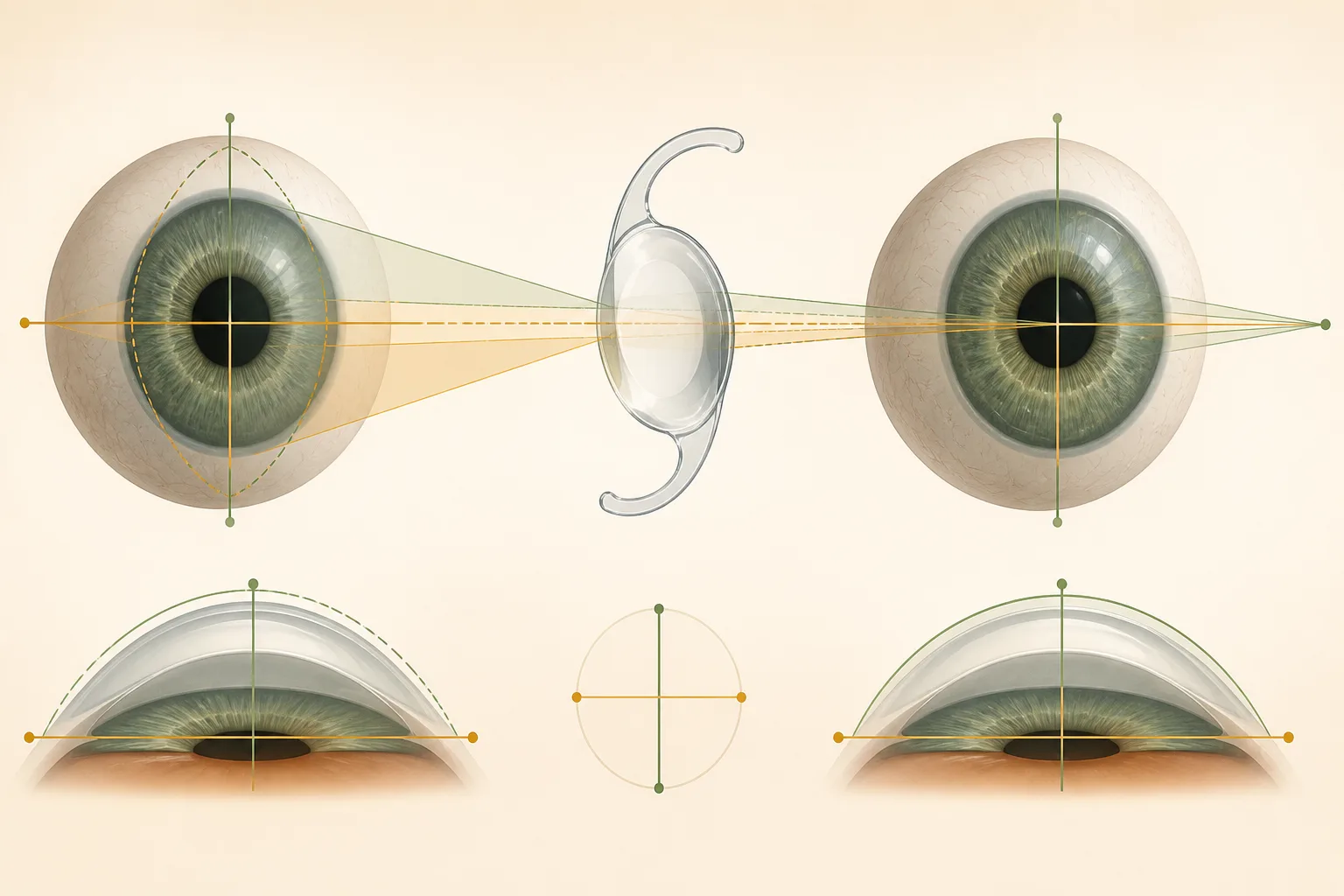
A toric IOL is not a separate vision-range category. It is the astigmatism-correcting version of a monofocal, enhanced monofocal, EDOF or full-range lens. The decision is whether regular corneal astigmatism needs correction—and whether the exact model and surgical plan suit your eye.
What is astigmatism, exactly? What does a toric lens actually do about it? And are toric lenses really "premium," the way some clinics price them? These three questions come up constantly, and the honest answers are more nuanced — and more useful — than the marketing language around them.
What astigmatism actually is
Astigmatism means the eye has different optical power in different meridians. In regular corneal astigmatism—the form a toric IOL is designed to address—the cornea is steeper in one direction and flatter in another. Astigmatism can also come partly from the natural lens, so preoperative planning separates the corneal component that will remain after the natural lens is removed.
Here is the simple picture I use: a regular spherical surface is like a football—a round soccer ball—or a basketball. A regularly astigmatic surface is closer to a rugby ball: it is curved differently in two directions. The eye is not literally shaped like a rugby ball, but that picture makes the two different optical powers easier to understand.
It is recorded as cylinder power, measured in diopters, and an axis, measured in degrees. Instead of one clean focus, uncorrected astigmatism spreads detail differently by direction, producing blur or the “ghosting” some people describe. It can occur alone or together with myopia or hyperopia.
Astigmatism is not an infection to cure. Its optical effect can be corrected with glasses or contact lenses, selected corneal procedures, or a toric IOL during cataract surgery or refractive lens exchange.
How a toric lens actually corrects it
A toric lens is built with its own deliberately uneven surface — engineered to cancel out your cornea's specific astigmatism rather than match it. Picture your retinal image as coming from two different-strength meridians; the toric lens adds an opposite-shaped correction so the two recombine into one clean, sharp image. It's the same underlying principle as astigmatism-correcting glasses or contacts, just built into the implant.
Toric is not a separate IOL category. Think of it as an option on the same car model: the main lens model can be monofocal, enhanced monofocal, EDOF or full-range, while the toric version adds the cylinder correction that a particular eye needs.
Visually, a toric IOL looks essentially identical to a non-toric one of the same model — the only visible difference is a set of small alignment marks etched onto the lens surface. Those marks are how your surgeon orients the lens to the exact axis measured before surgery, and it's also why toric correction only works if the lens actually lands and stays at that axis (see the rotation issue further down).
The marketing claim worth ignoring
A useful way to evaluate a toric lens is to move past slogans and ask about the complete correction plan: repeatable corneal measurements, treatment of dry eye before biometry, accounting for posterior corneal astigmatism, the selected cylinder power and axis, and how rotation will be checked after surgery. Surface-design claims alone do not tell you how accurately the eye will end up corrected.
Are toric lenses "premium"? Yes and no.
No, in the sense that matters most: if enough regular corneal astigmatism is left uncorrected, it predictably limits unaided sharpness. A toric IOL corrects that cylinder inside the eye during the cataract operation. It is not the only possible correction—glasses, contact lenses, selected corneal incisions or later laser correction may also address astigmatism—but it may be the most direct plan when the goal is clear vision without cylinder glasses at the chosen distance. The question is not whether “premium” sounds desirable; it is which correction plan is accurate and sensible for your eye.
Yes, in a narrower, practical sense: toric lenses are more complex to calculate and to implant. They require more precise pre-surgical measurement, more sophisticated equipment, and a surgical technique that keeps the lens rotationally stable after implantation — because unlike a spherical lens, a toric lens has to land at the correct axis and stay there. That extra complexity is real, and it's a legitimate reason some clinics price it differently. But it's a pricing decision about surgical complexity, not a statement about whether you medically need it.
Do you actually need one?
Toric IOLs are designed for regular corneal astigmatism. In comparative studies they generally leave less residual cylinder and provide better uncorrected distance vision than non-toric IOLs in eyes with corneal astigmatism. There is no single online threshold that determines who “needs” one: the amount and type of astigmatism, posterior corneal contribution, incision plan, chosen IOL category and your tolerance for glasses all matter. Irregular astigmatism may not be fully corrected by a toric IOL and needs individualized corneal assessment. Rotation matters because it reduces the intended correction; modern toric IOLs are usually rotationally stable, but some eyes require reassessment or repositioning.
Examples of exact toric models
“Toric” does not identify one range of vision. It tells you that the model includes astigmatism correction. The PanOptix, Vivity, enVista Aspire, TECNIS PureSee, TECNIS Synergy and TECNIS Odyssey reviews describe the toric version where relevant. These are examples to investigate, not a ranking or a recommendation for your eye.
Is a toric lens worth the extra cost?
The practical benefit is reducing the blur from regular corneal astigmatism at the distance your lens is designed for—not automatically giving you reading vision. If you choose a monofocal toric aimed at distance, you may see the view down the street more clearly without cylinder glasses while still needing reading and computer glasses.
Ask the clinic to compare the expected remaining astigmatism with and without the toric option. Then ask what that difference means for your actual tasks and what alternative correction is available. A price label does not answer either question.

One question to take to the appointment: “With my measurements, which glasses might the toric option help me avoid—and which would I still need?” For the broader question of paying for a lens upgrade, see are premium cataract lenses worth the extra cost?
Watch Oleksii's explanation of the distinction between toric correction and glasses freedom: Cataract, astigmatism, toric IOL, glasses and IOL selection (English, 2024). It explains the principle; clinical suitability still requires examination.
Frequently asked questions
What is a toric lens?
A toric IOL is an implant with cylinder correction designed to reduce regular corneal astigmatism. It can be monofocal, enhanced monofocal, EDOF or full-range.
Is toric the same as astigmatism?
No. Astigmatism is the optical condition. “Toric” describes a lens designed to correct a measured amount and axis of regular astigmatism.
What does toric mean?
It means the lens has different optical power in different meridians and must be aligned on the planned axis.
Do I need a toric IOL?
There is no universal online threshold. The answer depends on repeatable corneal measurements, the type of astigmatism, the incision and target plan, the exact IOL, and how much you want to reduce cylinder glasses.
Practical takeaways
- Are my eye measurements reliable, and do we need to treat any dryness before choosing the lens?
- How do you plan to correct my astigmatism, and how will you check the result?
- A toric IOL can improve uncorrected distance vision in suitable eyes, but it cannot guarantee zero residual cylinder.
- If vision is unexpectedly blurred after surgery, measurement of refraction and IOL axis is more useful than guessing.
- Irregular corneas require an individualized plan; a toric IOL is not automatically the best answer.
Sources and evidence
Sources support the medical and technical statements. Interpretation and plain-language explanations are Oleksii Sologub's.