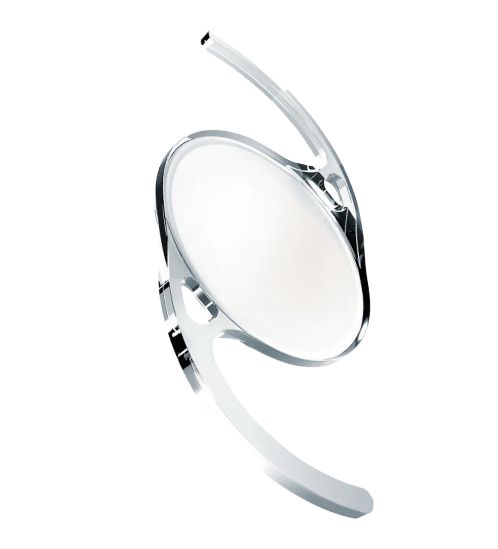
The simple answer
enVista Aspire is sold as a monofocal IOL with a little more range at arm’s length—the distance of a dashboard or many computer screens. It may deliver that. But the manufacturer’s own official safety information says that a clinically meaningful extension of depth of focus has not been demonstrated and that contrast sensitivity, glare and halos have not been clinically evaluated for the Aspire optical design.
For my own eyes, I would not take this level of evidence as enough. The manufacturer’s headline improvement comes from internal data and a theoretical model eye. The best peer-reviewed clinical study has only 29 eyes and no standard-monofocal comparison. If the brief were specifically “enhanced monofocal,” I still do not see a convincing evidence-based alternative to Eyhance today.
That does not mean Aspire is a bad lens or that its optical design is unsafe. It means a technically interesting lens has not yet given me enough clinical proof to prefer it for an irreversible decision.
What Aspire is trying to do
A standard monofocal IOL creates one main clear distance. An enhanced monofocal tries to make that clear zone a little wider, usually toward intermediate distance. It does not restore the natural autofocus of a young eye, and it does not promise the near range of a trifocal.
Aspire changes the back surface of the lens within its central 1.5 mm. The power increases smoothly toward the centre, with the aim of extending the focus zone without splitting light into separate focal points.
What the evidence actually says
| Question | Best available answer | What that means for a patient |
|---|---|---|
| Does it broaden focus? | Bausch + Lomb reports a 120% bench increase versus enVista, supported by internal data and a model-eye MTF test. | The design behaves differently in a laboratory. This is not yet proof of a 120% improvement in daily vision. |
| Does it work in people? | A 29-eye study found good distance and useful intermediate results. | The result is encouraging, but there was no standard-monofocal control, so the added benefit cannot be measured. |
| Has a fair comparison answered it? | The randomized comparison enrolled 27 people, but none reached the primary result visit. | The study produced no primary comparison at all. |
| What about contrast and halos? | The official safety information says these effects were not clinically evaluated for the Aspire optical design. | No worsening has been proven—but there is also no solid comparative evidence to reassure us. |
The 120% claim: read the footnote
On the Bausch + Lomb product page, Aspire is said to show a “120% increase in continuous depth of focus” versus enVista. The footnote matters: the claim is based on Data on File and optical-bench MTF testing in an ISO2 model cornea with +0.28 μm of spherical aberration.
MTF is a laboratory measure of how well an optical system keeps fine detail and contrast. Here the lens was tested inside a theoretical eye built from assumptions. That is useful engineering information. It is not a real person reading a phone, working at a screen or driving at night.
For the important difference between ISO2, ACE and implanted-patient evidence, read how IOLs are tested in the lab.
The manufacturer’s own official safety information is unusually direct: a clinically meaningful extension of depth of focus has not been demonstrated in clinical trials. It also says the effects of Aspire’s optical design on contrast sensitivity, glare and halos have not been evaluated clinically.
What 29 eyes showed—and what they could not show
The main peer-reviewed Aspire clinical study followed 29 healthy eyes in 29 people. Average corrected distance vision was 20/20. Distance-corrected intermediate vision at 66 cm averaged about 20/34, and near at 40 cm averaged about 20/38. The defocus curve kept roughly 1.5 dioptres of range at 20/32 or better.
In daily language: the results are compatible with a useful dashboard or screen range and some larger print at 40 cm. They do not prove comfortable phone reading or freedom from reading glasses.
The decisive limitation is simple: every eye received Aspire. Without a standard enVista MX60E group, we cannot know how much of that intermediate vision came from Aspire’s modified optic, the person’s pupil, residual refraction or the usual pseudoaccommodation seen with monofocal lenses.
The comparison that ended with zero answers
A randomized trial—a fair comparison in which the lens is assigned rather than chosen—was designed to compare Aspire with enVista MX60E and another slightly extended-focus IOL. It enrolled 27 participants: 11 received Aspire, 10 received the other enhanced monofocal and 6 received MX60E.
Then comes the number that matters: zero participants reached the primary 90–150 day outcome visit. The registry record says the study stopped because no additional evidence was required within its scope and that no IOL safety concern had been identified. That explains why it stopped. It does not create the missing comparison.
Two larger Bausch-sponsored studies were completed: one enrolled 82 people and another 335 people. As of 26 August 2026, neither registry page had posted results, and neither was designed as the clean Aspire-versus-standard-monofocal answer I would want before choosing a permanent implant.
What about contrast, halos and glasses?
A short conference report in 41 bilaterally implanted patients described high intermediate spectacle independence and mostly absent or occasional halos, starbursts and glare at three weeks. That is encouraging, but it was uncontrolled, short and used an abbreviated questionnaire.
So the honest answer is not “Aspire causes a contrast problem.” No such problem has been demonstrated. The honest answer is that comparative clinical data are too thin to tell us whether Aspire truly keeps a standard monofocal’s contrast and night profile while adding intermediate vision.
The 2025 recall is a separate issue
In 2025, Bausch + Lomb recalled enVista Aspire and other enVista-family lenses after reports of toxic anterior segment syndrome, or TASS—an acute inflammation inside the eye after surgery. The FDA classified the recall as Class I and listed the cause as process control. The company later narrowed the affected products to certain lots manufactured from September 2024 through March 2025, attributed the issue to raw material from a different supplier, added controls and returned the platform to market.
As of 26 August 2026, the FDA database still showed recall Z-1679-2025 as open. This is important lot and manufacturing history. It is not evidence that Aspire’s intermediate-vision optical design itself is unsafe. A clinic considering the lens should still confirm the exact model and lot against the recall list.
And the toric version?
The toric Aspire corrects regular astigmatism at the same time as cataract surgery. Its mechanical platform comes from the established enVista toric family, which has evidence for rotational stability. That supports the toric platform; it does not prove that Aspire’s modified central optic adds a clinically meaningful intermediate benefit. Those are two different questions.
My verdict
My conclusion is not complicated: there are no convincing comparative clinical data yet. Aspire may be a good lens. The 29-eye study gives an encouraging first result, and the design idea makes sense. But internal data, a theoretical model eye, case series and conference abstracts are not enough for me to choose it over an option with far more comparative clinical research.
For myself, I would not take that evidence risk. If I specifically wanted a monofocal-plus or enhanced-monofocal strategy, Eyhance remains the option I would choose today. That is a judgment about the strength of evidence, not proof that every Aspire result is worse or that Eyhance is right for every eye.
The evidence difference is large: the 2025 Eyhance systematic review included 31 studies, including 8 randomized trials. Aspire’s peer-reviewed clinical case is currently led by one uncontrolled 29-eye study.
Frequently asked questions
Is enVista Aspire an EDOF lens?
In the United States it is labelled as a monofocal IOL with an intermediate-optimized optic. It is intended to extend the focus zone slightly, not to provide the range expected from a full EDOF or trifocal lens.
Will Aspire let me use a computer without glasses?
Possibly, especially around 60–80 cm, but the probability has not been established in a strong comparison with a standard monofocal. Your target refraction, astigmatism, pupil and actual working distance all matter.
Is Aspire worse than Eyhance?
That has not been proved. What is clear is that Eyhance has much stronger comparative evidence. A difference in evidence quality is not automatically a difference in lens performance—but it changes how much uncertainty you accept.
Three questions for your surgeon
- For my eye and my real screen distance, why Aspire rather than your standard monofocal or Eyhance?
- What can I realistically expect to do without glasses, and what evidence supports that estimate?
- Which exact model and lot will you implant, and have you checked it against the 2025 recall list?
Sources: Bausch + Lomb Aspire product claims and footnotes; official Aspire safety information; 29-eye peer-reviewed study; terminated randomized trial; 82-person study registry; 335-person post-marketing registry; 41-person ESCRS report; FDA recall Z-1679-2025; manufacturer recall investigation update; 2025 Eyhance systematic review.