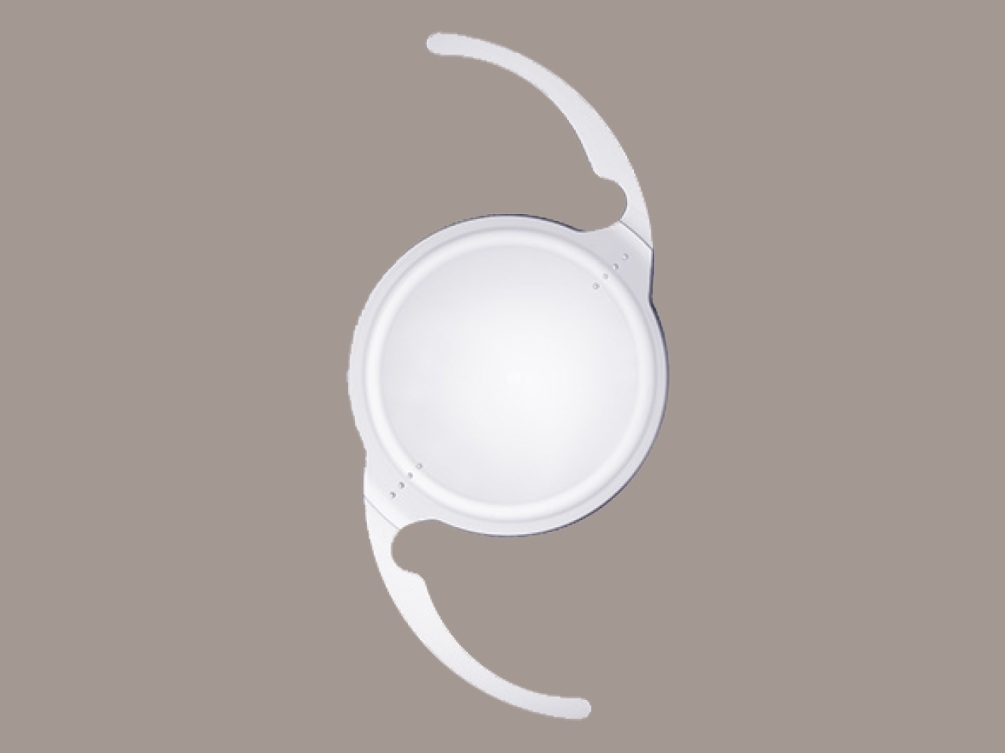
Eyhance: the simple answer
If you and your surgeon have already chosen a monofocal-style strategy, Eyhance is one of the best-supported ways to add intermediate depth of focus without deliberately moving into a trifocal design.
Here is my practical reading of the evidence: compared with conventional monofocals, Eyhance gives more intermediate range. In the outcomes studied so far, no clinically meaningful worsening was found in distance acuity, clinical contrast, halo/glare, or satisfaction. In plain language: the extra intermediate vision did not lead to worse distance vision, contrast, night-light symptoms, or satisfaction on average in the available studies. That is a strong and useful conclusion. It is not the same as saying that Eyhance is the best lens for every eye, or that it provides full-range glasses independence.
What this looks like in daily life
With both eyes targeted for distance, Eyhance may make a dashboard, kitchen counter, or computer at arm’s length easier than a conventional monofocal. A phone at 35–40 cm and small print in dim light will still commonly need readers.
So the honest headline is: same distance strategy, a useful intermediate bonus, and no promise at near.
Is there a downside versus a standard monofocal?
No clinically meaningful downside has been found in the comparative outcomes measured so far. That is the sentence I would use with a patient.
The one repeatable difference appears on an optical bench. Against the TECNIS 1-Piece ZCB00, Eyhance produced slightly lower peak MTF at best distance focus with small 2–3 mm apertures. At apertures of 3.5 mm and larger, that study found no MTF or halo-energy difference. Across defocus, Eyhance moved some optical performance toward the intermediate range, which is exactly where its clinical advantage appears.
The result depends on the model cornea and pupil size used in the test; it is not a universal ranking of the lenses.
Technical note: the model cornea in this study
This particular Vega et al. bench did not use a standard ISO2 or ACE cornea. It used an achromatic artificial cornea that induced +0.175 μm of fourth-order spherical aberration at a 5-mm IOL-plane pupil. So this is evidence from that specific setup, not a universal MTF ranking.
To understand why the model cornea and test conditions matter here, read how IOLs are tested in the lab.
ZCB00 begins from an exceptionally strong distance-quality benchmark. The small bench reduction with Eyhance has not translated into worse average distance acuity, clinical contrast, or patient-reported visual quality in comparative clinical studies. Another clinical optical-quality study found no significant difference in MTF cutoff, scatter, or Strehl ratio between ICB00 and ZCB00.
So I would not invent a worsening that has not been observed. I would keep one boundary around the claim: “no clinically meaningful worsening versus standard monofocals in the measured outcomes” is supported; “no possible downside for every eye, at every pupil size, for unlimited follow-up” is not something any study can prove. Standard monofocals cannot make that absolute promise either. An individual patient can still have glare, blur, or an imperfect result because of refraction, ocular surface, cornea, retina, optic nerve, pupil, or surgery.
Nor does Eyhance own this idea forever. Vivinex Impress, IsoPure, and Zoe Primus-HD may produce similar outcomes, but the 2025 review found only one non-randomized comparative study for each, with moderate or high risk of bias. Today, Eyhance has the more extensive research; that is not proof that competitors are inferior.
A separate randomized study compared three enhanced monofocals with a standard monofocal in 344 eyes. At 2 months, the enhanced lenses did better at tested intermediate distances, while average contrast and measured halo/glare did not differ significantly.
My bottom line
Eyhance is a strong default to discuss when a monofocal strategy has been chosen: it adds intermediate depth of focus, and the current clinical evidence has not shown that it gives up distance acuity, contrast, or a monofocal-like halo/glare profile on average. It is not automatically the right category when near independence is the main goal, when a required toric version is unavailable in the relevant market, or when another ocular condition changes the plan.
Questions for your surgeon
- At my phone and computer distances, what benefit is realistic and when will I need glasses?
- What focus target do you plan for each eye, and how will you address astigmatism?
- Do my eye findings change the expected benefit or make another lens a better alternative?
Sources: Fernández et al., 2025 systematic review and meta-analysis; Vega et al., ICB00 vs ZCB00 optical-bench study; clinical optical-quality comparison of ICB00 and ZCB00; Hayashi et al., randomized 344-eye comparison; Auffarth et al., randomized Eyhance vs ZCB00; FDA Eyhance approval record.
Compare the options
If PureSee is also on your shortlist, read PureSee vs Eyhance for computer work and reading.