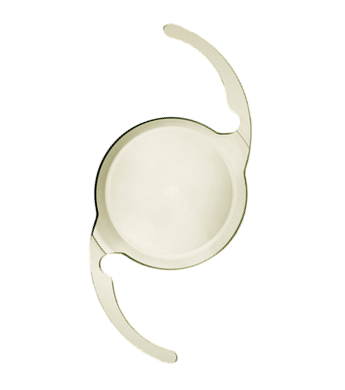
What TECNIS PureSee is
TECNIS PureSee is a non-diffractive, fully refractive intraocular lens from Johnson & Johnson Surgical Vision. It was approved by the FDA on March 11, 2026 under PMA P980040, supplement S176, as a non-toric model (DEN00V) and a toric line (DET150 / DET225 / DET300 / DET375, with cylinder powers of 1.50–3.75 D at the IOL plane; these are not corneal astigmatism values). It sits in the same general design family as TECNIS Eyhance — a continuous refractive change in curvature rather than diffractive rings — aiming to extend usable range without the halo/glare trade-offs typical of diffractive multifocal and trifocal lenses.
What it looks like
The image below is reproduced from the lens's own FDA regulatory filing, not manufacturer marketing artwork, so what is shown is exactly what the FDA reviewed and approved.

Source: FDA SSED, PMA P980040/S176, Figure 1
Where the data on this page comes from
Every figure below is drawn from the lens's FDA Summary of Safety and Effectiveness Data (SSED) — the public regulatory document FDA publishes when it approves a device, based on the clinical study the manufacturer submitted to obtain approval (PMA P980040/S176, approved March 11, 2026). This is a deliberate choice: it's the same underlying trial the manufacturer's own marketing draws from, but published in full by a regulator rather than selected and formatted for a sales presentation. We link the exact table each number comes from so you can check it yourself.
The full SSED now includes the near-vision and spectacle-wear tables that were missing from the first version of this review, so they are included below. The remaining limitation is simple: we mainly have one manufacturer-sponsored 6-month registration trial (roughly 115 PureSee patients and 113 monofocal-control patients across 9 U.S. sites), not years of independent long-term follow-up.
Visual acuity by distance
The study's main measure of effectiveness was intermediate vision at 66 cm, where PureSee showed a statistically significant advantage over the monofocal control lens (p<0.0001). Distance vision was measured as non-inferior to the control, which is the expected and appropriate result for a lens whose selling point is added intermediate range, not sharper distance vision.
Bars show relative acuity — longer bar = sharper vision. Exact logMAR value (lower is better) and Snellen equivalent shown at right.
Source: FDA SSED, PMA P980040/S176, Tables 20, 32 and 35
Distance vision was essentially tied with the control, while at 66 cm PureSee averaged about 20/28 versus 20/40 for the monofocal control—a 1.5-line advantage that met the trial's co-primary success criterion. In daily terms, that is the computer, dashboard and kitchen-work range.
Near vision and glasses: the tables that change the conversation
At 40 cm, average binocular distance-corrected near vision was about 20/38 with PureSee versus 20/49 with the control. This was a supporting result; the study had not been designed in advance to prove statistical superiority at this distance. PureSee therefore added near function, but the result is not full-range near vision.
The patient questionnaire makes that limit clearer. At six months, 26.5% of PureSee patients said they wore glasses for near vision none of the time, versus 8.2% with the monofocal control. Conversely, 40.7% of PureSee patients still used near glasses most or all of the time. For overall vision, 54.0% reported no glasses use, and 74.4% reported none or only a little of the time. These are descriptive questionnaire results; the study was not designed for a statistical comparison of spectacle wear.
Contrast sensitivity
Mean log units — higher is better. One eye tested with distance correction, in low light and without glare. cpd means cycles per degree: a higher number means finer stripes.
Source: FDA SSED, PMA P980040/S176, Table 21
Contrast sensitivity was close to the monofocal control at low and medium spatial frequencies, with a modestly lower reading at the highest frequency tested (12 cpd). The SSED states that every difference stayed within the study's own success criterion of 0.3 log units. The published table reports mesopic testing—contrast under low light—not a separate patient outcome for night driving.
Visual disturbances (halos, glare, starbursts)
% of patients who mentioned the symptom without being prompted by a specific question.
Source: FDA SSED, PMA P980040/S176, Table 22
These are spontaneous reports, not a directed severity questionnaire: patients mentioned the symptoms without first being asked to rate each one. The SSED states that none of the spontaneous PureSee reports of halos, night glare or starbursts were severe. In the separate directed questionnaire at 6 months (Table 24), each of halos, glare and starbursts had 3 of 113 PureSee patients (2.7%) reporting that it bothered them very much or extremely. The table does not say whether these were the same three people for all symptoms. The control percentages varied by symptom, so this table should be read row by row rather than summarized as one “monofocal-like” number.
Possible limitations, based on this data
- Average binocular distance-corrected near vision at 40 cm was about 20/38, and 40.7% of patients reported wearing near glasses most or all of the time. Near and spectacle wear were supporting descriptive results, not powered statistical comparisons.
- Night glare and starbursts were reported more often than with the monofocal control lens (4.4% vs. 1.8%, and 5.3% vs. 0.9% respectively), though absolute rates were low and none were rated severe.
- Contrast sensitivity at the highest spatial frequency tested (12 cpd) was modestly lower than the control lens.
- This is one 6-month industry-sponsored registration trial with 115 PureSee patients — a valid basis for FDA approval, but a smaller and shorter dataset than exists for older, more established lens designs.
- The spectacle-wear questionnaire is now available, but these results were descriptive and the study was not designed to prove statistical superiority for glasses use.
Who this lens may suit
PureSee is most coherent for a patient who prioritizes computer, dashboard and kitchen distances and accepts that sustained close reading may still need glasses. Its spontaneous halo reports were close to the monofocal control, but that does not prove a personal absence of symptoms. Medical suitability and the refractive target still require the surgeon's examination and measurements.
Questions for your surgeon
- What target will you use in each eye, and how would it shift my near point?
- For your PureSee patients, which tasks at 40 cm still need reading glasses?
- Do my cornea, retina or optic nerve make the trial averages less applicable?
- How will you check and correct residual astigmatism or refractive error?
How it compares
PureSee is part of the broader non-diffractive EDOF category — lenses that stretch a single focal point through refractive curvature changes rather than splitting light with diffractive rings. For the category-level trade-offs (versus standard monofocal, diffractive EDOF, and full-range/trifocal lenses), see EDOF (Extended Depth of Focus) and Non-Diffractive EDOF Lenses: A Newer Approach to Extended Range, which looks at how this design approach compares with earlier non-diffractive designs like Eyhance.
A note on how manufacturers present this same data
It's worth understanding how this kind of clinical data is typically packaged for marketing purposes, since it explains why an independent, source-cited summary reads differently. Manufacturer sales materials for lenses in this category commonly headline a single favorable comparison — for example, a bench-optics measurement (like modulation transfer function, a lab measurement of image contrast at a given pupil size) framed under a headline claiming broader "superior" real-world performance against a list of competitor lenses, even though the underlying test is optical-bench data rather than a patient-reported clinical outcome. The competitor lenses shown in any single slide are also a choice made by the manufacturer, not a complete or independently curated field. Much of this material is sourced from internal, unpublished "Data on File" studies rather than the peer-reviewed or FDA-published trials cited throughout this page, and is often explicitly labeled for distribution to healthcare professionals only, rather than for direct patient use — which is one reason we've built this page from the public FDA record instead of reproducing that material here. None of this means the underlying products are ineffective; it means marketing materials are optimized to persuade, while a regulatory filing is optimized to document — and the two are worth reading differently.
For a plain-language explanation of why model-eye choice matters, read how IOLs are tested in the lab.
Primary source
FDA Summary of Safety and Effectiveness Data, PMA P980040/S176 (March 11, 2026).
A note on this review
This page is educational content, not a personal recommendation. The figures and updated near/spectacle results come from the FDA's public SSED for PMA P980040/S176 and are identified by table or outcome. Actual outcomes vary, and a qualified ophthalmic surgeon must determine whether the lens and target fit your eye measurements and health.
Compare the options
For computer work and reading, see PureSee vs Eyhance. For contrast and everyday vision, see PureSee vs Vivity.