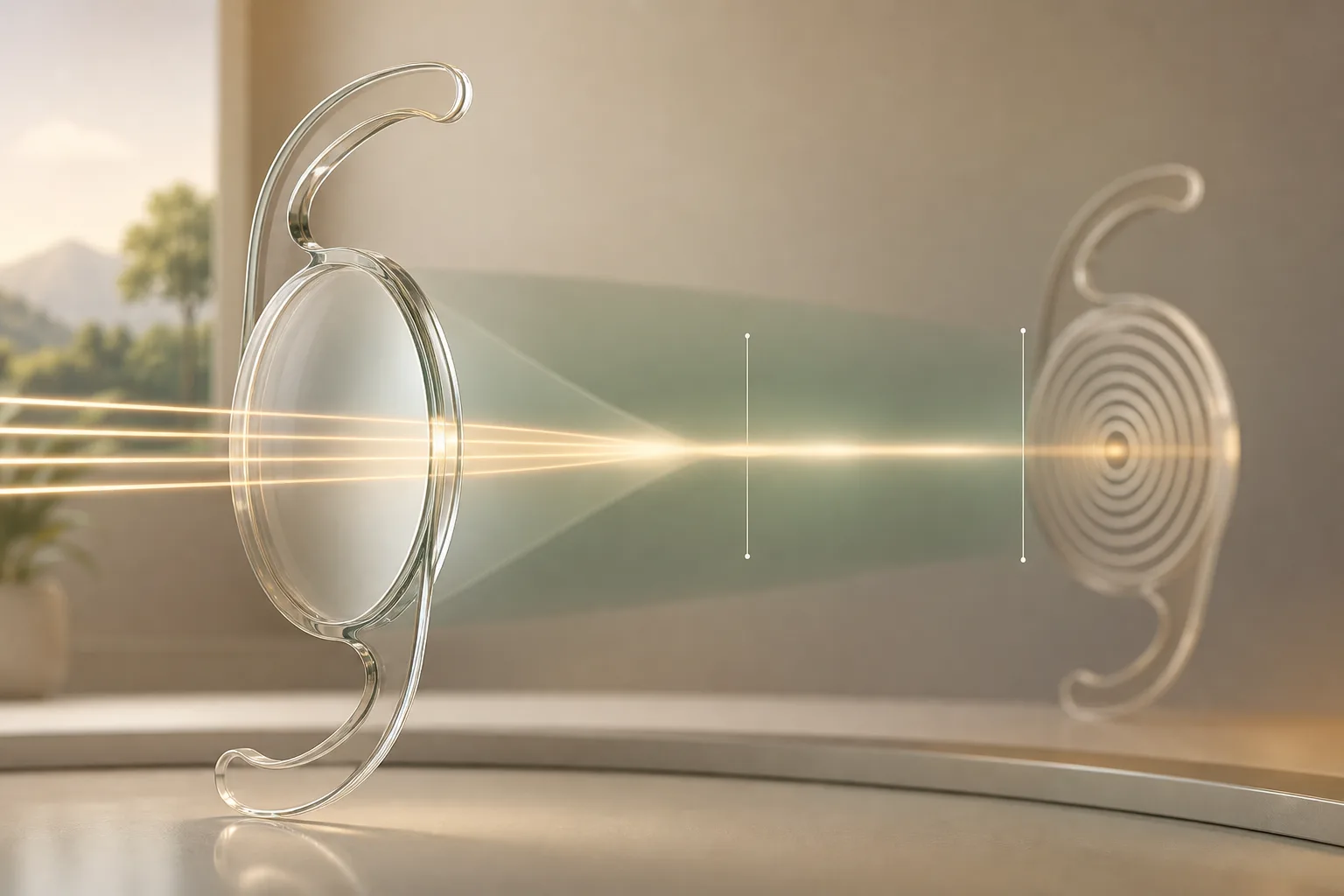
Extended depth of focus (EDOF) lenses have been available for several years, but the optical approach used to build them has kept evolving. A newer generation — PureSee, released in 2024, is one example — uses a fully refractive optical design with no visible diffractive rings or zones inside the lens. That's a meaningful design difference from earlier EDOF lenses, and it's worth understanding what it does and doesn't change for patients.

What "non-diffractive" means

Earlier EDOF lenses, such as Symfony, extend depth of focus using diffractive optics — concentric rings on the lens surface that bend light in a way that stretches the range of clear focus. Enhanced monofocals like Eyhance take a different route again, using a non-diffractive refractive shaping of the lens surface to add a smaller amount of intermediate range. The newer non-diffractive EDOF lenses build on that refractive idea more fully: the entire optic is shaped to extend focus continuously, without relying on distinct internal zones or diffractive steps to do the work.

Because there are no diffractive edges for light to scatter off of, this category of lens is generally associated with very few reports of night-time dysphotopsia — the halos and starbursts around lights that some patients notice with diffractive multifocal or EDOF designs. This is a reasonable expectation based on the optical principle involved, and early reports are encouraging, though as with any newer lens category, the long-term, large-scale real-world data is still accumulating.

Some published comparisons, including manufacturer-reported data, suggest non-diffractive EDOF designs may offer a wider "safety margin" for small refractive surprises than some enhanced monofocal lenses — meaning a somewhat larger share of patients land in a comfortable uncorrected-vision range even if the surgical result isn't perfectly on target. That's a useful property in principle, but it's a comparison drawn from specific studies and specific lens models, not a guarantee for any individual eye. How well it holds up for you will depend on your own anatomy, your surgeon's measurements, and the specific lenses being compared.

Three things to evaluate together, not in isolation

When you're comparing EDOF options — non-diffractive or otherwise — it helps to look at three properties as a set, rather than picking one number and judging the lens by it alone:

The defocus curve. This describes how vision quality changes as you look at objects nearer or farther than the lens's primary focus point. A flatter, wider curve generally means a more forgiving range of usable vision, but curves can look similar on paper while feeling different in daily life.

Night-time dysphotopsia risk. Halos and starbursts around lights are the most commonly reported side effect of lenses that reshape or split light, and they matter most in the situations you can't easily control, like night driving.

Contrast sensitivity. This is the most commonly overlooked of the three, and arguably one of the most important for everyday function — we cover it in detail separately, but in short, it's about how well you can make out low-contrast detail, not just how sharp high-contrast letters look on an eye chart.

No single lens optimizes all three simultaneously; every EDOF design, non-diffractive or diffractive, involves trade-offs among them.

The takeaway

Non-diffractive EDOF is a genuinely interesting evolution in lens design, and PureSee is a useful example of what the category is trying to achieve — but it's the category and its underlying optical principles that matter for your decision, not any one brand name. Ask your surgeon how a specific lens they're recommending performs on defocus range, halo risk, and contrast, and how those properties were measured, rather than relying on a single marketing claim. You can read a broader overview of this lens category on the EDOF lens options page.