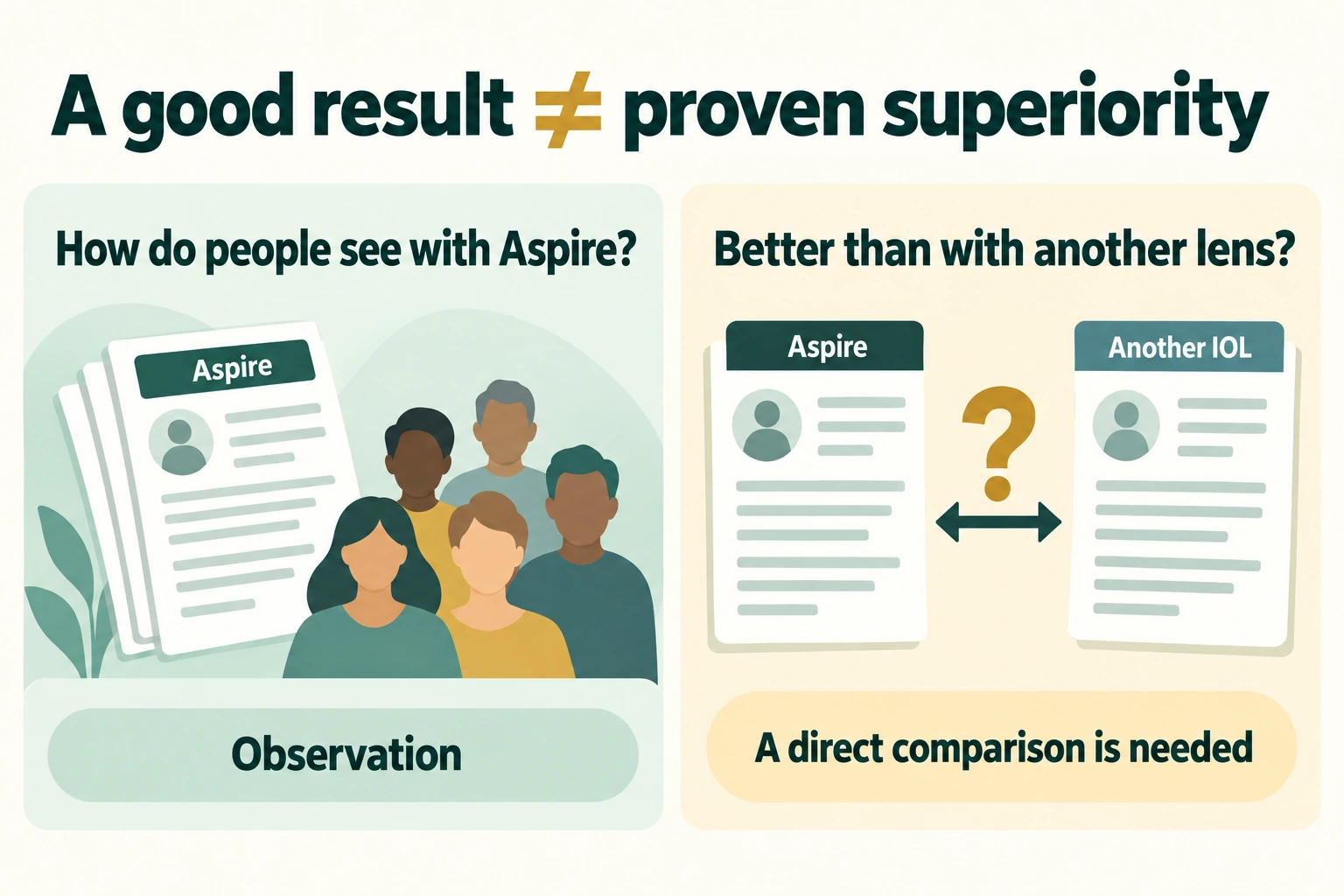
There is now a larger published clinical series to discuss. Its results are encouraging. But there is an important distinction: showing that people can see well with Aspire is not the same as showing how much better they see than with a standard monofocal lens.
This article adds to the earlier Aspire review. It does not repeat the full explanation of the lens or its laboratory claims.
What has actually been added?
The earlier review discussed a prospective study of 29 eyes. Donnenfeld and colleagues’ paper, published on 27 August 2026, describes 141 eyes from 84 patients treated by six US surgeons. It includes both Aspire and Aspire Toric, the version that also corrects astigmatism. These were existing clinical records, not a trial assigning people to competing lenses. Earlier study; new paper.
Here is the useful difference between the two reports:
| Question | Earlier 29-eye study | New 141-eye series |
|---|---|---|
| How was it organised? | Patients followed prospectively | Existing records reviewed from several surgeons |
| Which Aspire versions? | Non-toric | Non-toric and toric |
| Was another lens implanted for comparison? | No | No |
More observations are useful. They tell us more about outcomes outside one small study. What they do not create is the missing comparison.
Read the “100%” carefully
For intermediate vision with both eyes open and without glasses, everyone with an available measurement reached 20/32 or better: 27 of 27 in the Aspire group and 13 of 13 in the toric group. These are overlapping groups—not all 84 patients. Some people received one version in each eye. Results and Figure 2.
The result is worth reporting. It is not a guarantee that every Aspire patient will work comfortably at a screen without glasses.
20/32 describes the size of letters a person can identify on a test chart. It is not a score for reading speed, an hour of computer work or satisfaction. The visual-acuity explainer explains that distinction.
There is another practical detail: the centres did not use consistently recorded, standardised testing distances. So I would not turn this percentage into a promise about your screen at 60, 70 or 80 centimetres. That distance needs to be discussed separately.
The question I still want answered
Suppose your surgeon tells you that people in a study could see a useful amount at arm’s length with Aspire. Good. My next question is straightforward: how would comparable people have seen with the ordinary lens?
If both groups did equally well, the additional optical feature would not explain an advantage. If Aspire did better under the same conditions, we could start discussing how large the improvement was and whether it matters for your daily tasks.
This is why I separate two questions: “Can this lens produce a good result?” and “Does this feature add something useful compared with the alternative?” The first can be answered by observing results. The second needs a comparison.
The new paper does not make Aspire worse. It also does not establish superiority over a standard monofocal or Eyhance. A limit of the study is not a defect in the lens.
What the study cannot settle about visual quality
The records were incomplete, follow-up varied, and nine eyes deliberately targeted for short-sightedness were excluded after the data were reviewed. Symptoms were taken from clinical notes rather than a common questionnaire. The study was funded by Bausch + Lomb, which contributed to its design, interpretation and manuscript review. Methods and funding.
These details matter because a reassuring account of routine results is not the same thing as a deliberately designed check for contrast loss, troublesome light effects or rare complications. The paper recorded no serious adverse events in the available records; that cannot establish that rare risks do not exist.
The manufacturer’s current US safety page still states that a clinically meaningful extension of depth of focus has not been demonstrated in clinical trials, and that the optical design’s effects on contrast sensitivity and visual disturbances have not been evaluated clinically. The wording appears in the Aspire Toric, model ETA section and refers to the Aspire optical design. It is not a statement that no Aspire clinical paper exists. Official safety information.
In plain language: publishing another series of good outcomes does not automatically answer the specific questions left open in the labelling. To understand why laboratory results cannot do that either, see how lenses are tested in the lab.
A separate safety check: the 2025 recall
The recall must not be confused with the question about the optic. Bausch + Lomb narrowed it to specified lots and announced a return to market. The FDA record checked on 8 September 2026 lists recall Z-1679-2025 as open. Ask the clinic to check the exact model and lot against the applicable local notice; neither the brand name alone nor a reassuring clinical paper answers that question. Manufacturer’s revised notice; FDA record.
My reading of the new evidence
I would update the description of Aspire’s research: it is no longer enough to talk only about one small, 29-eye publication. There is a larger clinical report, and it deserves a fair reading.
I would not change the question I ask before choosing an enhanced monofocal: what improvement has been demonstrated over the ordinary option, and is it an improvement I will actually use?
If Aspire has been offered to you, measure the distance to your main screen. Think about whether your goal is to recognise something briefly or work comfortably for a long time. Those are much more useful starting points than the word “enhanced” on its own.
Three questions for your surgeon:
- What can I realistically expect to see without glasses at my usual screen distance?
- Why Aspire rather than your standard monofocal or another enhanced monofocal—and what comparison supports that choice?
- Has the exact lens model and lot been checked against the recall notices that apply here?
If you already have several proposed lenses, the IOL Decision Guide can help you organise your distances, priorities and questions before the next appointment. The aim is a clearer decision, not a promise that one model suits every eye.
This is an explanation of published research, not a personal prescription. Your surgeon must assess whether a lens is suitable for your eyes.