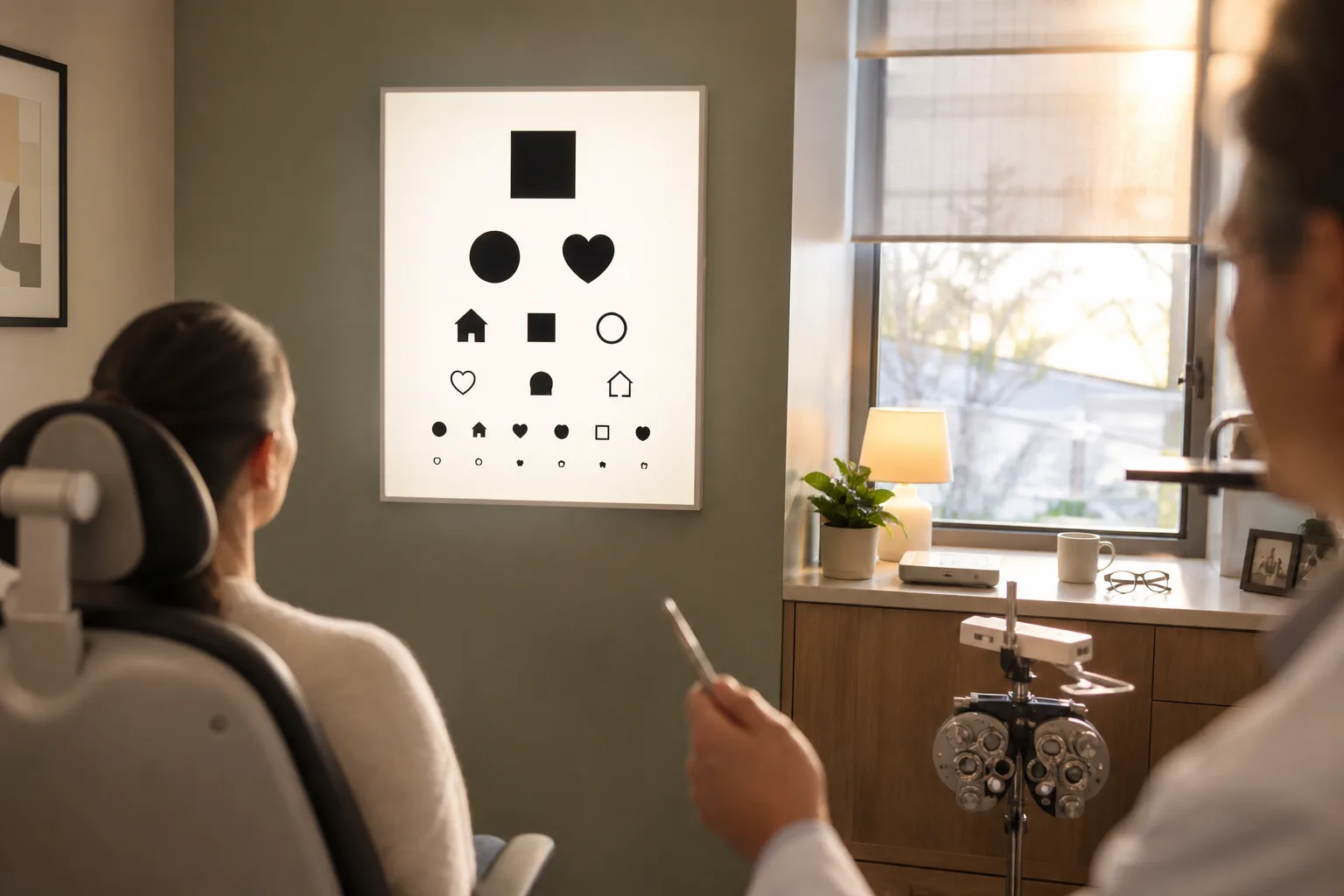
What "20/20" actually describes
The fraction "20/20" is a comparison, not a grade. The notation 20/20 uses a 20-foot reference distance (about 6 metres). Charts can be tested at other calibrated distances and the result expressed in this notation. The second number is the distance at which a person with "normal" vision could still read the same line of letters you just read. So 20/20 means you can read at 20 feet what a standard reference eye reads at 20 feet — the reference standard for that chart, not a measure of every part of vision and not a promise that vision will feel perfect. 20/40 means you'd need to stand at 20 feet to read what that reference eye can read from 40 feet away — your distance vision is less sharp than the reference. And 20/15 means the opposite: you can read at 20 feet what the reference eye needs to be at only 15 feet to read, meaning your acuity is sharper than the 20/20 reference. None of these numbers describe how "good" your vision feels in daily life — they describe one specific, narrow measurement: how small a high-contrast letter you can resolve at a given distance.
Why this specific test was designed the way it was
The test measures small high-contrast detail under controlled conditions. Results are most comparable when chart type, testing distance and procedure match. A prospective comparison of Snellen and ETDRS charts found that scores could differ even for the same eye.
What visual acuity does not measure
Precisely because the eye chart is built to be as easy as possible in every respect except letter size, it leaves out most of what actually makes real-world seeing hard. It says nothing about contrast sensitivity — your ability to make out a low-contrast shape against a similar-toned background, which becomes especially important in fog, dusk, or a dim room. It says nothing about glare or halos around bright lights at night. It says nothing about peripheral vision, depth perception, or how quickly your eyes adapt when moving from bright sunlight into a dim indoor space. And it says nothing about how your vision performs at intermediate distances, like a computer screen, or up close, like a restaurant menu — a standard acuity chart is a distance-vision test only. Two people can have identical 20/20 distance acuity and have very different real-world visual experiences, because acuity is only one axis of a much larger picture.
Why acuity can look "normal" even with a meaningful cataract
This gap between "measures well on the chart" and "sees well in daily life" is one reason cataracts can be more visually significant than a single acuity number suggests. In earlier stages, a cataract often reduces contrast sensitivity and increases glare sensitivity well before it meaningfully reduces the visual-acuity number itself — a patient can pass a 20/25 or even 20/20 line on the chart and still genuinely struggle to drive at night or read in dim light. This is exactly why an ophthalmologist evaluating whether cataract surgery is warranted looks well beyond the acuity number alone, factoring in a patient's actual reported difficulty with specific daily tasks.
Acuity after an IOL: what changes, and what a number can't tell you
After cataract surgery, visual acuity is one of the most commonly cited outcomes for a given intraocular lens (IOL) — manufacturer studies routinely report the percentage of patients reaching 20/20 or 20/25 at distance, near, and intermediate range. These figures are genuinely useful for comparing lens categories, but they carry the same limitation as any acuity measurement: they're typically measured under the same ideal, high-contrast, well-lit conditions as a standard eye chart. A lens that delivers excellent measured acuity can still come with more noticeable glare, halos, or reduced contrast sensitivity at night — none of which shows up in an acuity percentage, but all of which shape how a lens actually feels to live with day to day.
Reading acuity, and why "20/happy" is a real concept
Near acuity — how small a print size you can read up close — is usually reported using a similar logic but different notation (commonly a point-size or "J" reading-chart scale rather than the 20/20 format). Eye care professionals sometimes talk about "20/happy" vision — a deliberately informal way of pointing out that a patient's own satisfaction with their functional vision, doing the things that matter to them, is what ultimately counts, even when it doesn't map neatly onto a specific chart measurement. A result of 20/25 that lets you read comfortably, drive confidently, and work at a screen without strain is, for practical purposes, a better outcome than a 20/20 result that comes with glare severe enough to bother you every time you drive at night.
Bringing this into an IOL conversation
Visual acuity is a genuinely useful, standardized way to compare outcomes — but it's one input among several, not the whole picture. When discussing lens options with your surgeon, it's worth asking not only "what acuity can I expect" but also how a given lens is likely to affect contrast sensitivity and night vision specifically, since those are the dimensions an acuity number alone won't capture. See Understand Your Vision for how acuity relates to contrast sensitivity and night vision, and IOL Options for how different lens categories perform across all of these measures together.