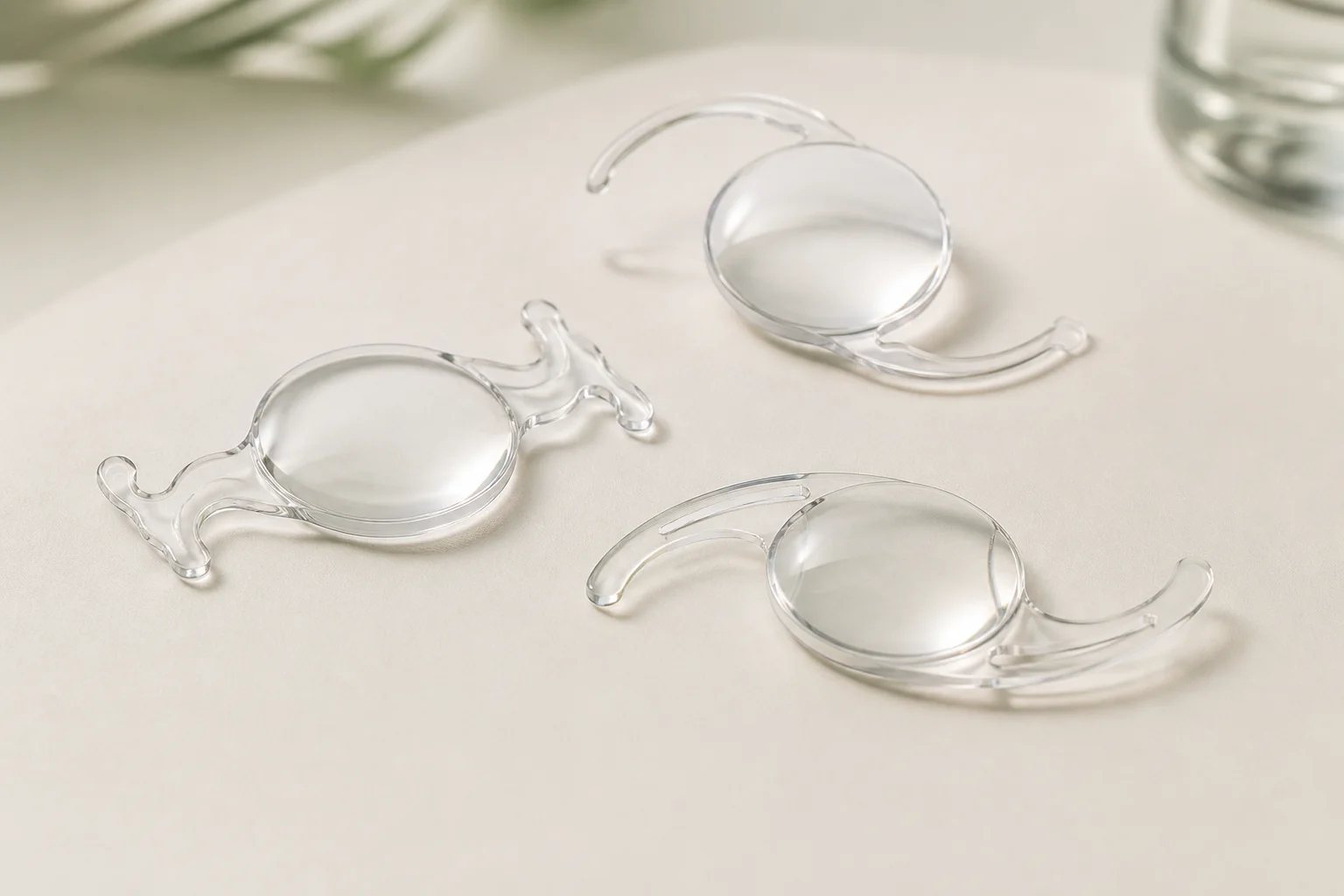
The useful improvement is usually at arm’s length
An enhanced monofocal tries to give you a little more arm’s-length vision than a standard distance monofocal. Think dashboard, kitchen counter, or a larger computer screen. Think improvement—not freedom from reading glasses.
Measure the screen before discussing the category
Suppose your screen is 65 centimetres away and your phone is 35–40 centimetres away. An enhanced monofocal may make the screen easier. It is much less likely to make small phone text reliably clear for long reading.
Distance still matters most. Intermediate is the bonus. Near—especially small text for sustained reading—usually still needs help.
The label does not tell you how large that bonus is. Different models use different optics and studies test different distances. A result at 66 cm cannot be quietly turned into a promise at 40 cm.
The category name does not tell you the size of the benefit
The attraction is a monofocal-style plan with a modest extension of focus. The limitation is equally important: the improvement is average, model-specific, and sensitive to the final refraction. It may be useful without feeling dramatic.
Do not choose this category because a brochure lists a higher Abbe number, a preferred filter, or a particular spherical-aberration value. Those are real technical properties. They become patient benefits only when clinical evidence for the exact model shows the claimed outcome.
Questions for your surgeon
- Which of my everyday tasks could this exact model make easier?
- What would I still need reading or computer glasses for?
- Why does it suit me better than a standard monofocal or another proposed option?
Sources: 2025 Eyhance systematic review and meta-analysis; Hayashi et al., randomized 344-eye comparison; Auffarth et al., randomized Eyhance vs ZCB00 study.
Read the individual model reviews
For the evidence and limits of specific models, read our TECNIS Eyhance review and enVista Aspire review.