What is new—and what is still diffractive?
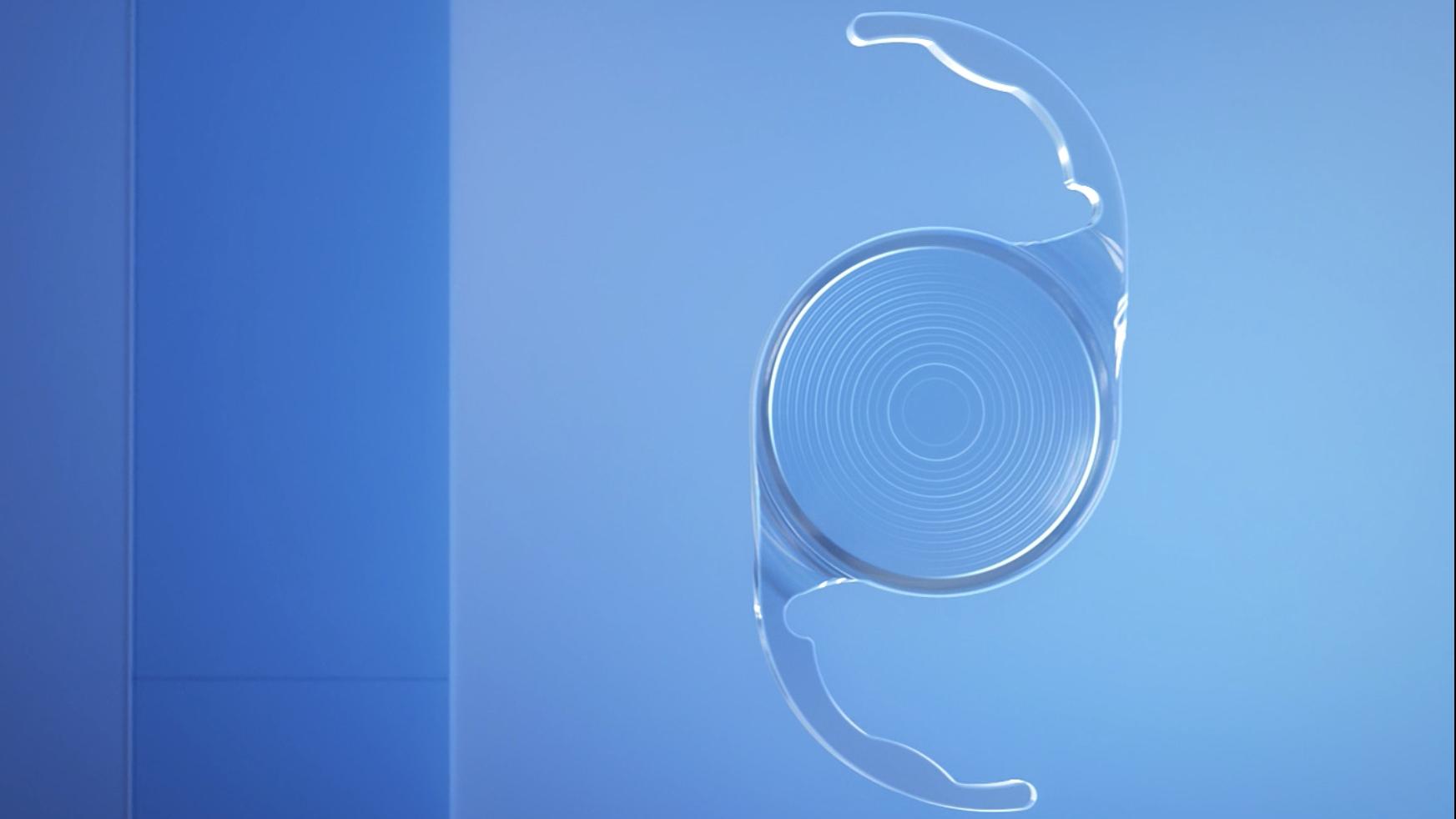
ZEISS presents AT ELANA 841P as a combination of its established trifocal optics and a hydrophobic C-loop platform. It has a 6 mm optic, a 13 mm overall diameter and a surface coating intended to help handling. The heparin fragment in that coating is not a pharmacological treatment for your eye.
It remains a diffractive trifocal: the optics create useful distance, intermediate and near focus by distributing light. A new material or supporting structure does not remove the optical compromises automatically. Nor do the many publications about AT LISA tri become the same number of studies of AT ELANA.

Manufacturer footnotes change the meaning
Some claims about optical performance rest on model-eye bench tests or virtual implantation in bright-light conditions. Those tests help explain the design; they do not measure how a person with dry eye experiences a wet road at night.
The product page's glistening claim also refers partly to the related CT LUCIA material and an internal definition permitting traces. Glistenings are tiny water-related changes inside the material. This is a different question from halos around lights, and neither a clear material nor an anti-capsule-clouding edge guarantees that every eye will remain symptom-free.
The published multicentre clinical study
A 2025 prospective report analysed 126 people after bilateral implantation, across 11 centres. At 4–6 months, average vision at 80 cm and 40 cm was useful. The participants were selected for otherwise healthy eyes and low astigmatism; there was no concurrent control group.
The paper reported no severe halos on non-directed questioning. That is not a validated, detailed finding of no halos at all. Its contrast comparison used historical middle-aged healthy-eye ranges, rather than a randomized monofocal control under identical testing conditions. The manufacturer funded the study; the authors declared no conflicts of interest.
These data support functional vision at several distances. They do not establish a comparative winner for night vision or contrast, particularly in eyes unlike those included in the trial.
A new one-year report is available—not an independent new cohort
The report published on 5 October 2026 describes 122 people at 12 months. Its original abstract reports 100% spectacle independence for distance and intermediate tasks and 88.5% for near tasks. These are selected-group questionnaire results, not a promise that glasses disappear in all circumstances.
It also reports posterior capsulotomy in 3.2% of eyes and no or only trace glistenings in 97.5% of eyes at the one-year visit—not every eye. One year cannot predict lifetime capsule treatment. The registry links this and the 2025 report to the same original study, so their patient numbers must not be added as independent replications. The full new report was not retrievable in this review; detailed safety and questionnaire interpretation remain limited to its accessible original abstract.
What about randomized and smaller studies?
A separate randomized trial against CT LUCIA 621P enrolled 284 participants and is registered as completed. At this review date, the accessible registry still had no posted results table. The existence of that trial is not the same as having its outcome data available, and an exact AT ELANA FDA SSED was not established by this search.
A smaller 2025 observational study enrolled 23 people and tested 66 cm intermediate vision. A correction was subsequently published. Its full text was not retrievable here, so individual numbers or a performance classification from that study are not used to establish a comparative conclusion. An abstract and metadata do not replace checking the corrected full report.
How much confidence does each claim deserve?
| Claim | Evidence-based interpretation |
|---|---|
| Useful distance, intermediate and near vision | Supported in selected single-arm clinical cohorts. Individual glasses need still varies. |
| Better contrast or fewer halos than another trifocal | Bench and historical comparisons are weaker evidence than a sufficiently powered randomized patient comparison. |
| No later capsule treatment | Not established. The one-year abstract reports capsulotomy; longer follow-up is needed. |
| A completed randomized study proves superiority | Not without accessible results for the relevant measures and the exact lens used for comparison. |
This is a claim-by-claim assessment, not a formal GRADE score or an approval verdict. How to read clinical data explains why a credible single-arm study can support performance without proving superiority.
What should a patient take from this?
AT ELANA is a genuine newer trifocal option with promising clinical results and a growing follow-up record. The sensible conclusion is to discuss it on its own measured results, not treat its connection to AT LISA or its material as proof of a perfect result. Compare with PanOptix Pro or FINEVISION only after matching distances, testing conditions and your eyes.
- Which available data apply to my eye health, astigmatism and previous surgery?
- What reading distance and night-driving compromises should I expect?
- What follow-up and treatment options are planned if the result is limited by glasses need, halos or capsule clouding?
Sources and editorial approach
- Official ZEISS product page: exact design, specifications and marketing footnotes.
- Janeková et al., 2025: full noncomparative multicentre report reviewed, including contrast methods, symptom questioning and funding.
- Mojžiš et al., October 2026: original one-year abstract reviewed; full-text access limitation stated.
- Original study registry and randomized study registry: cohort identification and results-posting status, not substitutes for outcome tables.
- Mendicute et al., 2025: original abstract and publisher metadata, small uncontrolled cohort. A subsequent correction is linked above; the corrected full report was unavailable.
- Oleksii's Synergy review: the evidence-critical approach to optical compromises, not personal approval of this new review.
Educational information—not a diagnosis or medical prescription. An eye-care professional must assess your eyes and medical suitability before treatment or surgery.