The short answer
PanOptix Pro is an updated Clareon trifocal, not a completely different way of restoring focus. The aim remains vision at distance, intermediate and near, with trade-offs such as halos and possible glasses use still relevant.
A randomized comparison in 83 implanted people found that corrected distance acuity met a prespecified standard for being no worse than the earlier Clareon PanOptix by an allowed margin. A conference report also describes preferences favoring Pro for some tasks and light effects. That supports a useful update—not a guarantee of twice-as-comfortable night vision.
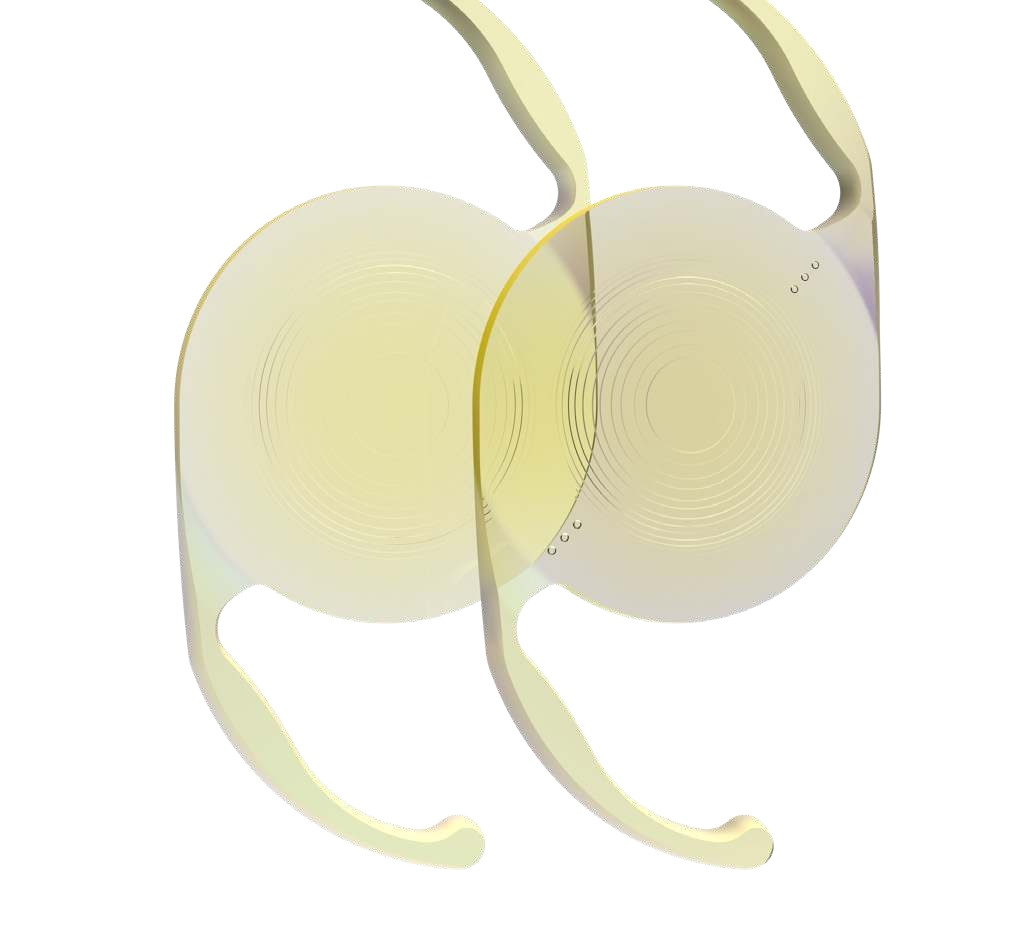
94% light use is not a 94% chance of success
Alcon's main optical claim is 94% light utilization, compared with 88% for the earlier design. In that model, light outside the intended useful range falls from 12% to 6%—hence the claim of half as much scattered light. These are optical test and simulation figures, not a clinical count of people who see halos.
Halving a modeled quantity of light cannot be translated into halving the chance of rings around headlights. Nor does 94% say that 94% of people will be happy, stop wearing glasses or see well at night. Those are different measurements.
This does not make the optical improvement irrelevant. It gives a reason to test the new design in patients. The next step is to inspect what those comparisons actually measured.
The strongest open direct comparison: 83 people, paired eyes
In Alcon-sponsored Study A, NCT06400745, 87 people were randomized; four withdrew before implantation. The remaining 83 each received Pro model PXYWT0 in one eye and Clareon PanOptix CNWTT0 in the other. Patients and the people assessing the results were masked to the allocation. This paired design reduces differences between people when comparing the two optics.
The posted main result was distance acuity at four metres, in bright conditions, with glasses correcting any remaining prescription, two months after surgery. Mean values were 0.032 logMAR for Pro and 0.023 for PanOptix; lower is better. The difference was 0.009—less than half a chart letter. The upper confidence bound, 0.0232, was below the study's allowed margin of 0.10, or one chart line.
So the trial met its non-inferiority test: it did not show a distance-vision loss exceeding the agreed margin. It did not prove Pro superior for this measurement, nor show the everyday result without glasses. The registry's posted results contain this main acuity measurement, not a full set of comparative patient halo ratings.
This is stronger evidence than an uncontrolled case series for the tested distance question. Its limits are the small sample, the specific measurement and follow-up, and manufacturer sponsorship. Meeting that question does not settle every marketing claim. See how to read clinical data for why ‘not worse by a margin’ and ‘better’ are different conclusions.
Encouraging patient preferences are not the same as symptom rates
An ASCRS 2026 conference abstract on the 83-person comparison reports follow-up through six months. Preferences favored Pro for distance clarity, and more respondents preferred its halos and starbursts than preferred the earlier lens. For clarity at 66 and 40 cm, preference was evenly split.
That is relevant to real experience. But choosing which of your two eyes you prefer is not the same as the percentage of patients bothered by halos after receiving Pro in both eyes. A conference abstract also gives less detail than a full paper about missing answers, statistical testing and the size of a meaningful change.
Treat these findings as supportive, not as a personal probability or a demonstrated halving of symptoms. The paired-eye study also cannot directly establish how often a bilateral Pro patient will need glasses.
A quiet footnote matters: some symptom percentages are from older PanOptix
The Pro product page presents low rates of being very bothered by halos, glare and starbursts. Its cited pooled analysis concerns the earlier AcrySof PanOptix, across 11 studies—not a clinical Pro-only dataset.
Those older results help explain experience with the PanOptix family. They should not be relabeled as the exact risk for PanOptix Pro. Optical equivalence between earlier AcrySof and Clareon PanOptix also does not establish that a newly modified Pro optic produces identical patient symptoms.
The manufacturer's own safety information still describes possible halos, glare, starbursts, reduced contrast compared with a monofocal, and continued glasses use. Less simulated stray light is not a promise to remove those trade-offs. See glare and halos and why contrast sensitivity matters.
Which FDA data belong to which model?
FDA supplement P190018/S029 was approved on 18 December 2023 for a minor optical modification to Clareon PanOptix. Its listed models include the PXYWT0 family tested in Study A. The public entry checked here does not link a standalone Pro SSED.
The original PanOptix review discusses its separate, earlier FDA evidence. That report should not be presented as a new Pro superiority trial. Likewise, Study B, NCT06401551, used a different modified optic, PAYWT0: its results must not simply be added to the PXYWT0 Pro results.
Ask your surgeon for the exact model and current local instructions. ‘Clareon’ identifies a lens platform; ‘PanOptix’ and ‘PanOptix Pro’ do not mean every optical result is interchangeable. A toric option addresses astigmatism; a favorable result in the non-toric study does not establish a new toric superiority claim.
What about Pro versus Odyssey?
A separate 2026 retrospective comparison matched 98 people, 130 eyes, across Pro and Odyssey. At one month, a small corrected-distance difference favored Odyssey; the authors questioned its practical importance. Missing measurements, no random allocation and routine symptom notes rather than a validated questionnaire limit the conclusion. No significant difference is not proof of equivalence.
This study is useful because it compared the actual lenses, not separate marketing charts. It still cannot establish a broad winner, long-term comfort or suitability for eyes excluded from the study. It reported no industry funding. Read alongside the Odyssey review, not as a replacement for an examination.
What to ask before choosing Pro
Do not start with whether Pro is the newest. Start with the tasks for which you want less reliance on glasses and the light effects you are willing to accept. Health of the eye and the planned target refraction remain part of the decision.
- Which exact model would I receive, and which clinical data apply to it?
- Do the expected benefits concern corrected chart acuity, vision without glasses, or patient comfort—and by how much?
- Given my eyes and night-driving needs, what trade-offs remain, and when might I still need glasses?
Our conclusion
There is a credible optical reason for the Pro update and a direct randomized patient comparison supporting preservation of corrected distance acuity. Early patient preferences are encouraging for some aspects of vision. These are useful findings, not evidence that the previous PanOptix is a poor lens.
The stronger claim—half the halos, broadly better real-world vision or guaranteed spectacle independence—does not follow from the figures reviewed here. Choosing Pro can be a discussion about a measured refinement, while keeping the usual trifocal compromises and the remaining uncertainty visible.
Related owner video
Oleksii's original PanOptix review (2021). It explains the earlier lens, not PanOptix Pro; current Pro evidence is assessed separately above.
Sources and their limits
Sources checked 11 October 2026. Editorial review by IOL Adviser. The review describes published evidence; it is not a prescription or a personal medical assessment.
- Alcon: PanOptix Pro claims, footnotes and safety information. Manufacturer source. Separates optical testing from the pooled earlier PanOptix symptom study.
- ClinicalTrials.gov: Study A, NCT06400745. Full registered design and posted results checked. Randomized paired-eye comparison; sponsor Alcon. Stronger support for the specified corrected-distance question, not every daily-life claim.
- ASCRS 2026: Visual Outcomes through a Next Generation Trifocal Lens. Conference abstract; supportive preferences, less complete reporting than a full clinical paper.
- FDA: P190018/S029. Primary approval record for the optical modification, not a claim of superiority.
- ClinicalTrials.gov: Study B, NCT06401551. Different PAYWT0 optic; not pooled into this Pro conclusion.
- Alomar et al., Cureus 2026: matched Pro–Odyssey comparison. Full methods, results, missing measurements and disclosures checked. Retrospective, short follow-up; no industry funding reported. Does not establish equivalent symptom profiles.
Educational information—not a diagnosis or medical prescription. An eye-care professional must assess your eyes and medical suitability before treatment or surgery.