The short answer
FINEVISION HP has substantial randomized clinical evidence for better near and intermediate chart vision than a standard monofocal. It also produces more halos and starbursts than that comparison lens. Good distance chart scores do not mean identical contrast, effortless night driving or guaranteed freedom from glasses.
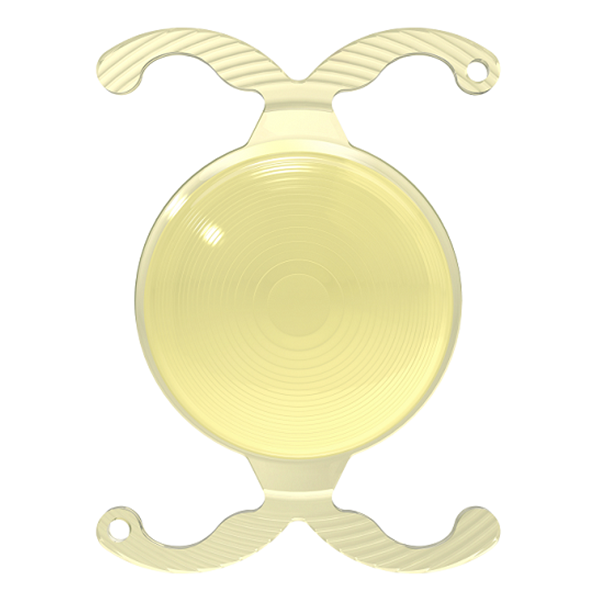
This review concerns the hydrophobic, non-toric POD F GF model. Earlier hydrophilic FINEVISION and HP Toric are related products, not interchangeable datasets.
What the manufacturer promises
BVI describes a trifocal hydrophobic lens that reduces dependence on glasses from distance to near. Its brochure highlights high spectacle-independence figures and a design intended to manage halos and glare. These are different claims: reading ability, glasses use and comfort need their own patient measurements.
Some brochure references concern the wider FINEVISION family, earlier designs or other lenses sharing a platform. A large family dataset should not automatically become the exact probability for POD F GF—or proof that every version behaves identically. Nor does a design intended to reduce a symptom prove that the symptom disappears.
What the FDA study actually tested
FDA approved FINEVISION HP on 10 September 2025. Its open SSED describes a prospective, randomized, double-masked comparison at 20 US sites with the monofocal AcrySof SN60AT. Both eyes received the assigned type. The report lists 539 screened candidates, 512 randomized people, 496 implanted and 474 completing the 12–14-month visit. These are people, not four different totals of eyes.
The main acuity comparisons were at six months, in bright light, with any remaining distance prescription corrected. Near vision at 40 cm favored HP by about 3.9 chart lines; intermediate vision at 66 cm by about 1.8 lines. Both differences were statistically significant. This is stronger support than an uncontrolled series for those specific comparisons.
Corrected distance acuity met the agreed ‘not worse beyond a margin’ test. That is not a superiority claim. The mean actually slightly favored the monofocal; the upper confidence bound stayed below the allowed one-line margin. Correcting residual prescription for testing also does not tell you that everyone reads that well without glasses.
The trade-off is visible in the same report
At the one-year questionnaire, 56 of 315 HP respondents—17.8%—reported halos very often, compared with 4 of 159 monofocal respondents—2.5%. That is frequency, not the proportion severely troubled by them. The separate severity and bother tables use only people who reported that symptom, so their percentages have different numbers of people or eyes counted.
The FDA summary also notes more starbursts with HP and less perceived trouble with night driving in the monofocal group. More HP patients nevertheless said they would choose the device again. Satisfaction and an optical compromise can coexist.
Average distance contrast sensitivity favored the monofocal under all tested lighting conditions at one year, although FDA considered the differences not clinically meaningful in this study. That does not mean the measurements were identical or predict one person's night vision. Read why contrast matters and what halos can feel like.
Safety reporting should not be edited out
The SSED reports one first-eye lens removal attributed to optical properties. It also reports 10 haptic breakages during loading or injection among 661 HP implants; five required removal of the initial lens after insertion. Investigation considered incorrect injector loading the likely cause, and instructions, warnings and training were updated.
These are different events with different numbers of people or eyes counted—not a combined personal complication rate. They belong in an honest review, without implying that the lens routinely fails or hiding the corrective action.
Who the trial does not represent
Participants had cataracts and selected eyes. Previous corneal refractive surgery, significant corneal abnormalities, glaucoma and severe dry eye were among exclusions. The tested non-toric group also had low pre-existing corneal astigmatism. Results cannot be transferred unchanged to every patient or to every toric model.
The manufacturer-submitted randomized study provides stronger evidence for near and intermediate improvement than a marketing testimonial. Its comparison lens was a standard monofocal, not PanOptix Pro or Odyssey; follow-up was about one year. It cannot establish the best premium lens overall. See how to read clinical data.
Longer follow-up and the toric version: useful, but different evidence
A 2023 randomized, single-centre study compared hydrophobic POD F GF with hydrophilic POD F in 46 people. Both groups had useful vision, but only 24 participants attended the two-year visit. That substantial loss to follow-up weakens confidence in long-term results. The spectacle-use questionnaire was collected at three months—not two years—and should not be advertised as a two-year independence rate. The study was funded by PhysIOL, part of BVI; the author also disclosed BVI research grants.
A separate randomized 110-person study also reported two-year follow-up for the two materials. We could verify its published abstract, not its full report; it is supportive context, not a basis here for extracting unverified detailed claims.
For HP Toric, a 2024 retrospective, single-centre report followed 62 eyes in 34 people for six weeks without a comparison group. Vision and residual astigmatism were encouraging, but contrast and a formal quality-of-vision questionnaire were not measured. Estimated rotation came from aberrometry, a less direct method than inspecting the lens after pupil dilation. The paper's results and discussion contain inconsistent refractive percentages; we therefore do not use those percentages as a precise promise. The lead author disclosed BVI consultancy and lecture fees. This is less reliable evidence for comparative toric performance, not the non-toric FDA randomized trial.
Three questions before choosing
- Which exact FINEVISION model would I receive, and which evidence applies to it?
- How do my eyes and reading distance change the expected result?
- What would I trade for less glasses use, particularly for night driving?
Our conclusion
FINEVISION HP is a credible trifocal option with a meaningful near/intermediate benefit shown against a monofocal. The same evidence makes halos, contrast and night-driving compromises visible. It supports a considered choice, not a universal winner.
Compare the different evidence behind PanOptix and Odyssey; do not rank them by numbers taken from unrelated trials. Oleksii's review of lens claims and patient measurements illustrates this approach, not a personal FINEVISION clinical review.
Sources and evidence limits
- FDA SSED P240038: exact POD F GF model, randomized study, tables 24 and 17–19, safety and exclusions. Stronger direct evidence for comparison with SN60AT; not proof of superiority to other premium lenses.
- BVI 2026 HP/HP Toric brochure: manufacturer claims and their original footnotes; family/platform references must be distinguished.
- BVI technical sheet: POD F GF specification, not an outcome study. Regional wording is inconsistent between its pages; check current local labeling rather than treating a footer as worldwide availability.
- BVI product page and image: identifies the hydrophobic model and source of the official illustration.
- Ang, 2023: randomized hydrophobic/hydrophilic study: 46 people, only 24 at two years; glasses-use answers at three months. Full article checked; BVI research grants disclosed.
- Khoramnia et al, 2023 two-year randomized comparison: 110 patients; abstract checked only, not treated as a fully appraised report.
- Daya et al, 2024 HP Toric report: 34 people/62 eyes, retrospective and uncontrolled, six weeks. Full article checked; no contrast or formal symptom questionnaire, inconsistent refractive percentages, disclosed manufacturer relationships.
Educational information—not a diagnosis or medical prescription. An eye-care professional must assess your eyes and medical suitability before treatment or surgery.