The manufacturer claim—and the useful question behind it
BVI markets ISOPURE as a premium monofocal lens providing distance and functional intermediate vision without compromising visual quality, in different lighting conditions. The useful question is more specific: how much extra reach was measured, at which distance, and compared with what?
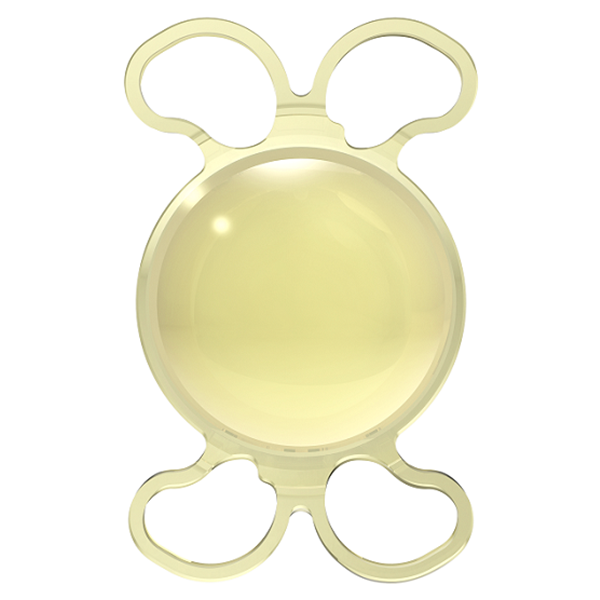
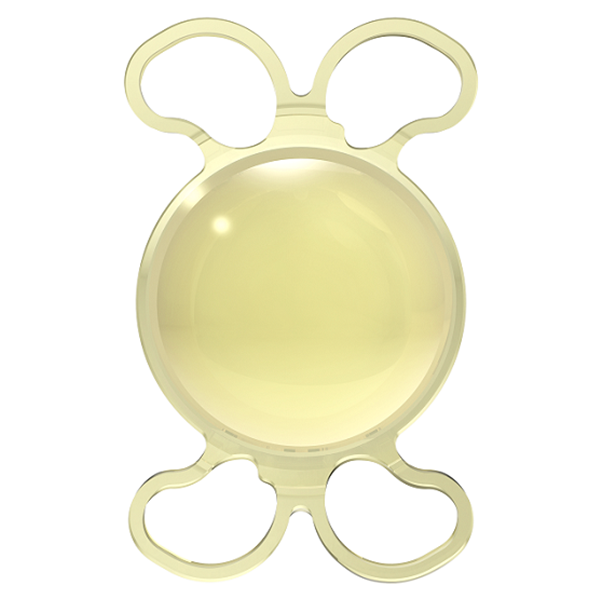
ISOPURE uses a smoothly shaped refractive surface rather than diffractive rings. The model in the main trial was the hydrophobic ISOPURE 1.2.3. The 1.2.3 name identifies the preloaded product; it is not a claim of three separate viewing distances. Do not confuse it with the diffractive FINEVISION family.
This review concerns ISOPURE 1.2.3. The newer ISOPURE Serenity has different supporting-loop geometry; its exploratory disease-specific reports are not automatically evidence for the exact model reviewed here.
The strongest directly relevant comparison
A 2023 prospective randomized study assigned 127 people to ISOPURE or MicroPure: 65 and 62, respectively. MicroPure is a standard monofocal on a similar material platform. Both eyes were aimed at distance, and follow-up was four to six months. Patients were masked to their lens assignment.
Participants were selected for cataract surgery without important additional eye disease, significant dry eye, previous corneal surgery or more than 1 D of corneal astigmatism. This makes the comparison informative for similar eyes, but not proof for every patient seen in a clinic.
| Binocular result | ISOPURE versus MicroPure |
|---|---|
| Intermediate vision at 80 cm | 80% versus 46.8% reached 20/25 or better with distance correction in place. |
| Intermediate vision at 66 cm | 67.7% versus 40.3% reached the same distance-corrected threshold. |
| Near vision at 40 cm | Only 7.7% of ISOPURE patients reached distance-corrected 20/25 or better. Better intermediate vision does not automatically provide fine-print reading. |
Distance correction removes residual focusing error during testing. These are not the percentages who could work or read comfortably without any glasses. A letter-chart threshold is also not the same as reading fluently for an hour.
What about distance quality, contrast and halos?
Corrected binocular distance acuity was very good in both groups: 98.5% and 100% reached 20/20 or better. Uncorrected distance results were not identical, so the study should not be presented as showing better distance vision with ISOPURE.
Measured average contrast and reported halo/glare size and intensity were similar between groups. That supports a reassuring comparison in this selected sample. It does not establish exact equivalence in every lighting condition, and the symptom scores do not mean that nobody experienced halos.
The authors asked for larger, longer studies with additional visual-quality and satisfaction measures. Short follow-up cannot determine a lifetime capsule-clouding rate, rare complications or a patient's eventual need for glasses.
Further comparisons: lighting, Eyhance and longer follow-up
A separate randomized 48-person study compared ISOPURE with MicroPure for three months. Its results table supports better intermediate acuity in bright light, but not a significant difference in dim light. The conclusion uses broader wording about both lighting conditions. The table and results section deserve more weight than that summary; “better in all lighting” is not established by this study.
A 2026 retrospective comparison included 69 eyes from 51 people: ISOPURE versus Eyhance. Fixed-distance acuities were not significantly different; Eyhance performed better at some nearer points on the focus-range test. Allocation was not randomized, the planned targets were slightly short-sighted, and testing was monocular. Contrast and patient-reported visual quality were not assessed. This is a useful comparison, not a definitive winner. The report declares no study funding but lists an author’s industry relationships.
A three-year report followed 34 of an original 50 people with ISOPURE in one eye and FINEVISION HP or Triumf in the other. Fifteen of the 34 ISOPURE eyes had needed YAG treatment for capsule clouding. That matters and should not disappear behind high satisfaction. But the selected returning sample, missing participants and mixed-lens design do not give a universal personal risk or establish the result of bilateral ISOPURE. The authors declared no financial or proprietary interests; contrast was not measured at this follow-up.
Where the evidence is strong—and where it is not
For an intermediate benefit against MicroPure in selected distance-targeted eyes, the randomized comparison is more reliable than a testimonial or an uncontrolled case series. The trial registry names BVI as the industry sponsor; an author disclosed BVI research grants. Sponsorship does not erase the findings, but it should be visible.
Other papers use different comparisons or mini-monovision, sometimes leaving one eye around −0.50 D. Those results must not be added to the distance-targeted trial as if the settings were identical. Nor does this trial rank ISOPURE above Eyhance, PureSee, LuxSmart or Vivity: they were not its comparison group.
See how to read clinical data for why randomized does not mean conclusive for every claim. The BVI product page and technical sheet state that ISOPURE is not FDA-approved for the US. This review does not attach an unrelated FDA dossier to the lens; local availability and instructions need separate checking.
The practical conclusion
ISOPURE can be discussed when you prioritize distance and a somewhat broader computer range, while accepting that reading glasses may still be part of life. If your main goal is small print at 35–40 cm, the evidence above is not a reason to promise independence from glasses.
Your actual screen distance, contrast needs and eye examination matter more than the category label. Compare Eyhance or PureSee using their own evidence. Oleksii's video on enhanced monofocal approaches gives background, not a personal review of ISOPURE.
- What should I expect at my actual computer and reading distances?
- Will both eyes be aimed at distance, or is mini-monovision part of the plan?
- Which findings in my eyes could make the study results less applicable?
Sources and their limits
- BVI ISOPURE product page: commercial claims, model identity and current US availability wording.
- BVI technical data sheet: hydrophobic lens specifications, not proof of a clinical outcome.
- Ang et al, 2023 randomized ISOPURE/MicroPure comparison: full methods, results, discussion and disclosures checked; 127 people, four to six months, selected eyes.
- NCT04249492: prospective trial record and BVI sponsorship. A registration is not an additional independent patient dataset.
- Pérez-Sanz et al, 2023 optical and randomized clinical comparison: full report; 48 people, three months, bright/dim results distinguished from the broader conclusion. Bench predictions are not patient outcomes.
- 2026 ISOPURE/Eyhance comparison: full primary publication; retrospective, 51 people/69 eyes, three months, monocular results and industry disclosures.
- Three-year ISOPURE/FINEVISION mix-and-match follow-up: full report; only 34/50 returned, capsule-clouding treatment and mixed-lens limitations. Not a bilateral ISOPURE trial.
Educational information—not a diagnosis or medical prescription. An eye-care professional must assess your eyes and medical suitability before treatment or surgery.