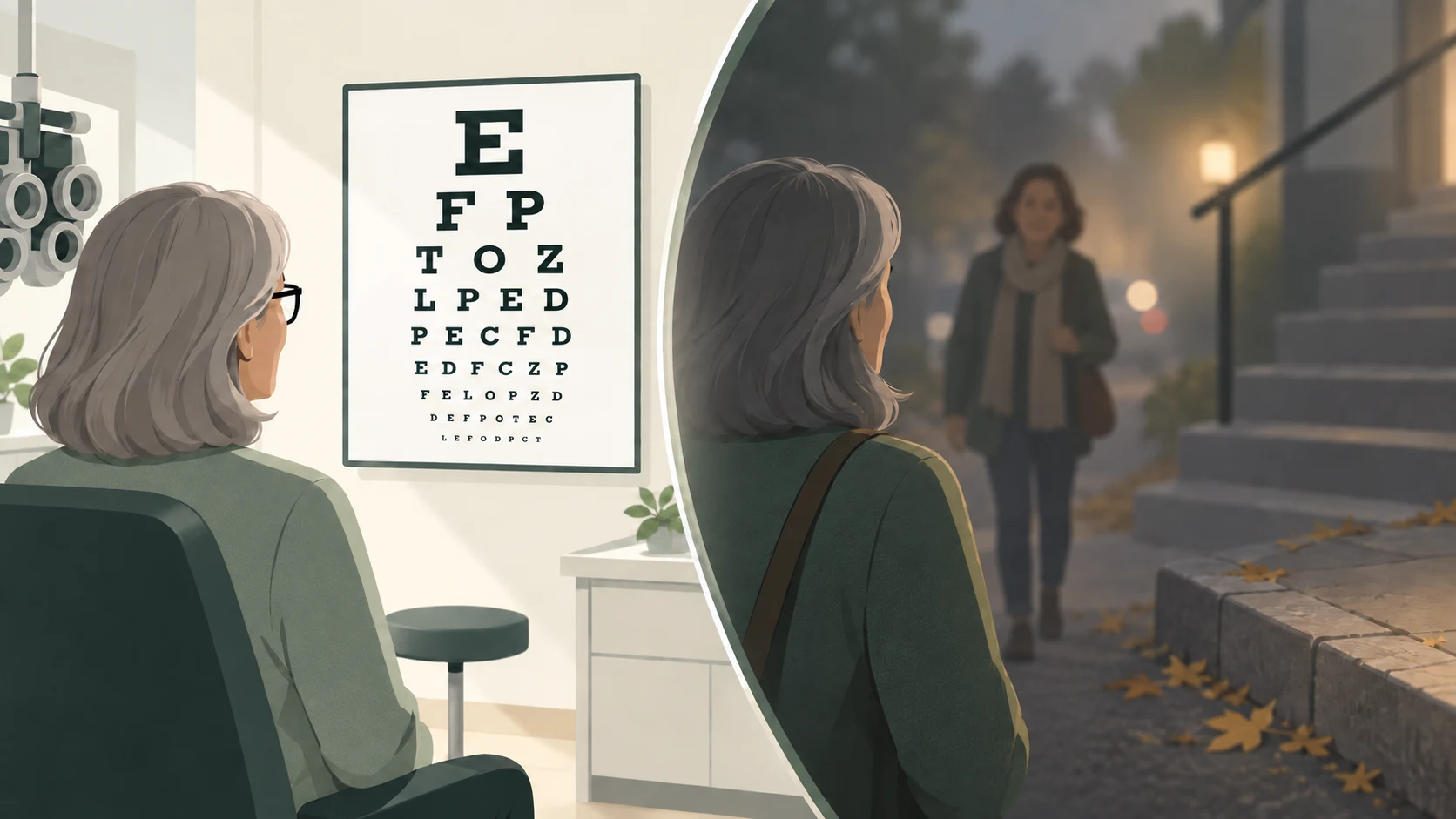
The eye chart is not a bad test. It answers one important question: can you recognise small, high-contrast symbols at a fixed distance, in controlled light? It does not, by itself, answer how easily you will read for an hour, use a computer in your own room, or drive in rain after dusk.
That difference is worth explaining clearly. Not because a good chart result should be dismissed, but because “I see well” is too vague for a useful conversation.
What the clinic is checking
The familiar letter chart measures visual acuity: the smallest high-contrast letters you can recognise at a set distance. It is a necessary starting point. Here is a simple explanation of what visual acuity measures.
Your clinician may also check whether a glasses correction makes the image sharper. This matters after cataract surgery because a small remaining prescription can affect a particular distance. The exact tests should follow the complaint, not a universal shopping list of machines.
So the chart is a good answer to one question. The mistake is asking it to answer every other question as well.
What a chart cannot tell on its own
The chart does not reproduce your kitchen, your screen, a dark stair, or a wet road with headlights. It does not ask whether the difficulty starts after five minutes or after half an hour. It does not tell the clinician whether one eye is doing most of the work.
Three examples make the difference clearer:
- You can recognise letters, but important details disappear in shadow or haze. That is the territory of contrast sensitivity, not simply “a dimmer picture.”
- You can read a short sample in good light, but ordinary reading becomes tiring. Being able to recognise text is not automatically the same as reading comfortably for the task you actually have. I explain that difference here.
- You see well during the day, but lights spread, glare, or halos become the problem at night. Those are different visual effects, and they are worth naming rather than calling everything “bad night vision.” Here is the distinction.
None of these complaints proves that an implanted lens is wrong. A remaining prescription, the eye surface, the cornea, the retina, and other parts of the eye can matter too. The point is simpler: the complaint gives the clinician information that the chart does not contain.
This is not just a philosophical distinction
In one prospective study of 85 people with symptomatic cataract, researchers measured high-contrast distance acuity alongside glare, contrast, reading and a validated questionnaire about day-to-day visual function before and after surgery. Changes in the patients’ reported function were linked with changes in glare, some contrast measures and reading performance. In that group, the change in corrected distance acuity was not linked with the reported improvement in daily visual function. Charalampidou and colleagues.
That does not mean the chart is useless. It means a clean line of letters is not the whole outcome. Another study measured real tasks such as face recognition, reading speed and orientation alongside conventional clinical tests.
In Elliott’s small study, after surgery on the first eye, participants recognised faces better, read newspaper-sized print faster and hit fewer obstacles on a test route in dim light. These were measured improvements in specific tasks, as well as in eye-chart results. Elliott and colleagues.
When you speak with your ophthalmologist, describe the problem clearly and specifically so they can decide what to check next.
How to describe a real visual problem
“My vision is bad” is true, but it leaves the next step unclear. Try to describe the problem in this order:
- What exactly are you trying to do? Read a book, use a computer, recognise faces across a table, see steps, or drive.
- At what distance and in what light? Name the usual distance and whether the problem appears in dim light, glare, rain, shadow or a bright room.
- What happens, and when? Is the image blurred, are details missing, do lights spread, do your eyes tire, and is it one eye or both? Does it happen immediately or only after time?
For example: “I can read the letters in your room. At home I can read a book for five minutes, then the print feels harder and I slow down.” Or: “The road is clear in daylight, but headlights in rain make it difficult to judge what is beside the road.”
This is not a script designed to win an argument. It is a better description of the problem. It helps separate a possible remaining prescription from a surface problem, a light-related symptom, a reading-distance issue, or something else that needs examination.
Three useful questions for your surgeon
- “Could a remaining glasses prescription or another eye problem explain this particular difficulty?”
- “Which check would best match the problem I have described: reading, contrast, glare, or something else?”
- “What result is realistic for this task, and what can we still change?”
If vision is newly or markedly worsening after surgery, or you have pain or increasing redness, contact your surgical team promptly rather than trying to explain it away with an article.
The point is not to pass the chart
The goal after cataract surgery is not to collect a good number in the clinic. It is to see well enough for the life you actually lead.
The chart stays important. Your own description makes it useful.
Watch a related explanation
Contrast sensitivity and its impact on your vision — IOL Adviser, English. This video complements the article; it is not a diagnosis or evidence for a particular lens.
Sources
- Charalampidou et al. — Prognostic Indicators and Outcome Measures for Surgical Removal of Symptomatic Nonadvanced Cataract
- Elliott et al. — Improvements in clinical and functional vision and perceived visual disability after cataract surgery
- Samadi et al. — Improving Patient-Assessed Outcomes after Cataract Surgery
This article is educational. It cannot diagnose the cause of a visual problem or choose a lens for a particular eye.