Published Odyssey studies give us a more useful answer than “there are almost no data.” They report good vision across several distances. They also show why noticing a halo, finding it troublesome and being satisfied with the operation are three different things.
This is a new analysis alongside the previous Odyssey review. Several papers discussed here were already published before that review and were not included in it. Calling all of them “newly published research” would hide that omission.
First, the job this lens is trying to do
Odyssey is a lens designed to reduce dependence on glasses from near to far. It is not a standard monofocal with a small extra intermediate zone. The structure of its optic distributes light to support vision across distances; it does not restore the young natural lens’s ability to change shape and refocus. See the explanation of full-range lenses.
For you, the relevant question is not whether the name contains “full range.” It is whether you can do your normal tasks comfortably, and how you feel about the light effects that can accompany this type of optic.
A useful review therefore needs to look at three things separately: distance range, contrast and light effects. A good result in one does not automatically answer the other two.
What the additional papers measured
The studies are not interchangeable. Different participants, tests and follow-up periods can produce different-looking results without either report being a description of what every Odyssey patient experiences.
| Paper | Who was studied, and when? | What it adds |
|---|---|---|
| Bissen-Miyajima, 2025 | 25 people, both eyes implanted; one month | Vision at several distances, contrast sensitivity in bright conditions and a symptom questionnaire |
| Hacopian, 2026 | 40 people, both eyes implanted; at least three months | Acuity in bright and dim conditions; a structured questionnaire separating symptom frequency from bother |
| Hayashi, 2026 | 90 eyes from 90 people; three months | Direct comparison with Synergy and PanOptix; only the published abstract was accessible for this review |
The first two studies did not have another lens group in the same study. They help describe Odyssey results. They do not, by themselves, prove that it is better than another model.
The useful finding: frequent does not always mean unbearable
In Hacopian’s study, 13 of 40 people said they always noticed halos. Nobody selected the most severe answer, “Extremely,” for how much the halos bothered them. But some did report meaningful bother: Table 2 includes “Somewhat” and “Quite a bit” responses. Zero in the last category is not zero inconvenience. Original questionnaire results.
That is a much more useful conversation than “the lens has no halos.” A person can notice rings around lights and still value the freedom from glasses. Someone else may find a similar effect unacceptable for their evening activities.
Neither person is wrong. And neither can decide from a percentage with the question removed.
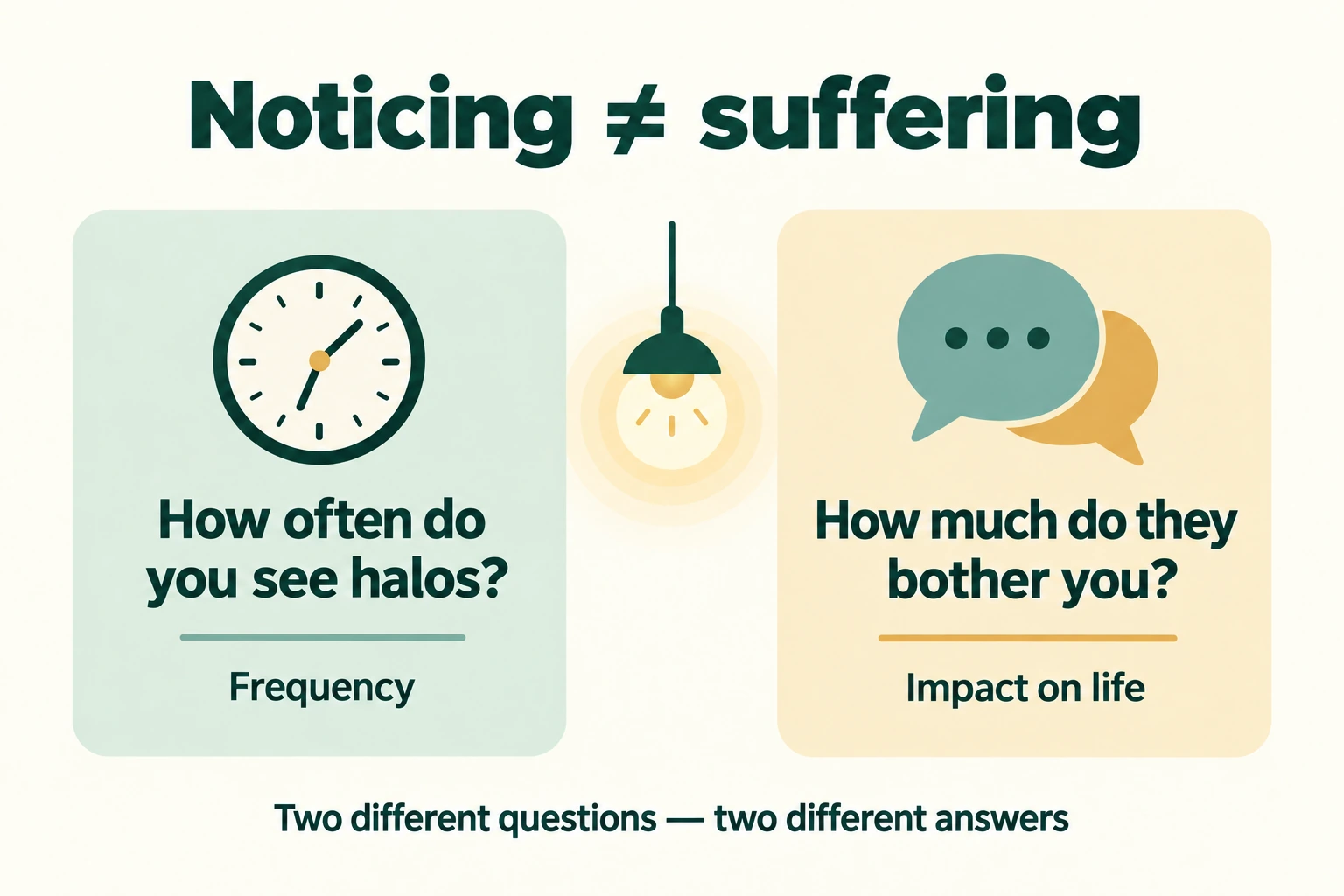
The practical questions are different:
| What we ask | What the answer tells us |
|---|---|
| Do you notice it, and how often? | Whether the effect occurs in that person’s experience |
| How strong is it? | The person’s assessment of the effect’s intensity |
| How much does it bother you? | Its reported impact—not simply whether it is visible |
These are not successive stages that every patient goes through. They are different descriptions of an experience.
Why I would not put “3% versus 48%” on a comparison chart
The earlier review included a report in which one of 30 people mentioned mild halos during routine follow-up. That is the source of its approximately 3% figure. Symptoms were not collected with a standardised questionnaire. Yuen and colleagues.
Bissen-Miyajima’s group used a five-level questionnaire one month after surgery. Its Figure 3 shows 36% reporting moderate halos and 12% severe halos: 48% combined. The abstract says 52%; the main results and the graph support 48%. I use the graph’s breakdown and make the discrepancy explicit. Figure 3.
It would be easy to build a dramatic headline from those percentages. It would also be misleading. One is a routine report of a mild symptom; the other is a graded answer about symptom intensity in another group at another time.
The way people were asked can contribute to the difference. We cannot calculate how much of the difference it explains from these studies alone. Nor can we decide that one country’s patients “tolerate halos better” from these numbers.
Reading an eye chart is not a complete contrast test
Think about reading a dark sign against a pale wall, then trying to distinguish a dim object against a similarly dim background. The second task asks more of your ability to separate an object from its background. That is the point of contrast sensitivity, not simply a picture looking more colourful.
Bissen-Miyajima’s study measured contrast sensitivity with both eyes open in bright conditions and reported results within its normal reference range. That is useful information. It is not proof that Odyssey preserves a standard monofocal’s contrast in every lighting condition.
Hacopian’s work tested letter acuity under bright and dim illumination. Lowering the light is not the same as gradually lowering the letters’ contrast. I would not relabel that result as a full contrast-sensitivity test.
The Hayashi abstract reports a favourable Odyssey result for letter acuity at 10% contrast in dim light. This is another specific test: how small a low-contrast letter someone can identify. It is related to contrast sensitivity, but not the same measurement.
For a person who drives at night, the missing step matters. A laboratory or clinic test helps us understand one part of vision; it is not a direct driving-safety test or a guarantee of comfortable night driving.
What about the direct comparison with Synergy and PanOptix?
The published Hayashi abstract reports a mixed pattern: Odyssey did better without glasses at far distances and around one metre, but worse at 50 centimetres and at 30 centimetres. The apparent far-distance advantage was not significant after correcting the remaining focusing error with glasses. Published abstract.
That is worth investigating, not turning into “Odyssey wins” or “Odyssey loses.” A screen at half a metre and a screen at one metre are different visual tasks.
Access limit: I could not inspect the full methods and tables for this comparison. I therefore do not estimate the size of its practical advantage, call it randomised or use it to rank the three lenses. It is a reason to ask a more precise question about working distance.
My conclusion
Odyssey has more published clinical evidence than our earlier review described. That correction should be made plainly. There are measurements of vision across distances, structured patient reports and clinical contrast testing—not just the two short series previously discussed.
My practical reading is that Odyssey is a serious option to discuss when near-to-far freedom from glasses matters. The available studies do not justify promising that light effects will disappear, that everybody will stop using glasses or that one model is best at every distance.
The strongest lesson here is simple: ask not only whether people see halos, but whether the way they were measured tells you anything useful about the life you want to lead.
How much confidence should we put in these reports?
Bissen-Miyajima’s report states no study or publication funding, while disclosing relevant industry relationships, including with J&J. Hacopian’s study received a J&J investigator-initiated grant. Both are small, short studies without a simultaneous comparison lens. Their funding and design do not erase the results; they set limits on how confidently we can generalise them.
A regulatory approval and a clinical publication are also different things. The FDA record for Odyssey Toric II is an approval record; a journal article supplies a particular set of observations. Difficulty finding one regulatory evidence document must not be turned into “there are no clinical studies.”
The small published glaucoma series is not permission to apply these conclusions to every person with glaucoma. It involved selected patients and did not measure contrast sensitivity. That decision still needs an individual assessment of the disease and the eye. Glaucoma study.
Three questions for your surgeon:
- What should I expect without glasses at my own phone and screen distances—not only on the standard test chart?
- When your patients report halos, do they simply notice them, or do they interfere with evening activities?
- Given my eye examination and priorities, why Odyssey rather than the other lens you would offer me?
If you already have a shortlist and are struggling to translate the studies into your own priorities, a consultation can help organise that comparison and the questions to take back to your surgeon. It does not replace the eye examination or determine medical suitability.