What the manufacturer promises
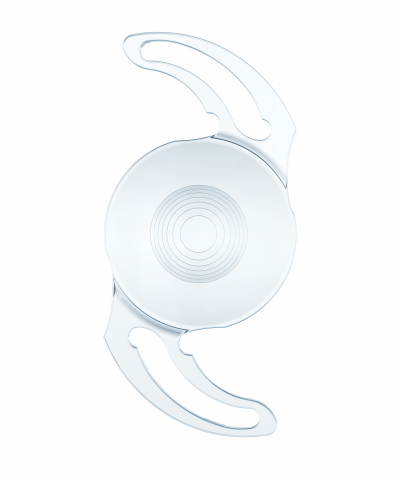
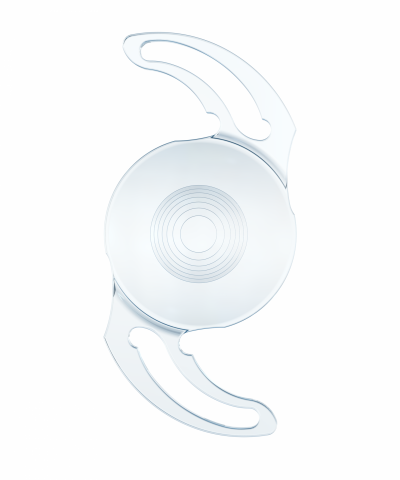
Medicontur presents Liberty as a trifocal lens for distance, intermediate tasks and reading. Its FEVeR explanation emphasizes fewer diffractive steps and useful light across different pupil sizes. Those are design claims, not proof that every patient reads comfortably in dim light.
The optic combines a central diffractive area with an outer refractive area. It uses hydrophilic acrylic containing 25% water. The 677MY, newer preloaded 677CMY and toric 677MTY must not be treated as interchangeable with an older 677PMY or an AddOn lens. The toric version adds astigmatism correction; it does not create a separate range-of-vision category.
Liberty versus AT LISA tri: an interesting comparison, not a verdict
A 12-month single-centre study compared Liberty with AT LISA tri. Only nine Liberty recipients remained in the analysis after three of the original twelve were lost to follow-up. Treatment choice depended on financial considerations, rather than random allocation.
Near and intermediate results were broadly comparable. Some daylight contrast measurements favoured Liberty, but that does not establish superior night driving. A small, non-randomized comparison can be affected by who received each lens and who returned for testing.
There is also a useful reporting warning: the paper describes less later YAG laser treatment with Liberty as significant, while the stated comparison gives p = 0.1171. That number does not support the usual claim of a statistically significant difference. YAG opens a cloudy capsule behind the implant; it is not replacement of the lens. The observed difference is a question for better research, not a proven advantage.
Liberty versus FineVision: which distance matters?
A 2025 comparison of 31 people in each group found small differences: Liberty did better on some near tests with one eye, while FineVision did better with both eyes at 67 cm. The differences were less than one chart line. A statistically detectable difference is not automatically a noticeable improvement during an hour at your computer.
Patients entered the two groups sequentially, not through random allocation, and follow-up was three months. The comparison concerned the hydrophilic FineVision POD F, not the newer FINEVISION HP. It did not measure contrast or a validated comparison of disturbing light effects. It cannot settle which lens is better for night driving.
A newer model does not automatically mean better screen vision
A 2026 report comparing Liberty generations found no statistically significant difference in its main test of intermediate vision with both eyes: p = 0.052. The numerical result favoured 677CMY, and some additional tests were better. That is encouraging, but a more favourable secondary test cannot replace the result of the study's main question.
This small retrospective report reused earlier groups of patients. It is not another independent replication. The newer version includes optical refinements as well as a different delivery system; their exact details were not fully disclosed. A claim of better everyday vision still needs evidence for that particular claim.
Freedom from glasses does not mean freedom from halos
In a 2026 three-centre series of 95 people, 94.4% reported never wearing glasses, while 31% reported halos. These answers can both be true: you can read without glasses and still notice rings around headlights.
The study combined spherical and toric lenses, cataract surgery and refractive lens exchange. It had no control group and followed selected patients for three months. Some visual-acuity units and thresholds are inconsistent in the report, so this review does not repeat those exact numbers. How to read clinical data explains why attractive percentages need these details.
The clinical papers disclose no external funding or no conflicts where stated; lack of a declared conflict is not a guarantee against bias. The manufacturer's light-efficiency calculations remain laboratory information, not a substitute for patient contrast testing.
What should you take from this?
Liberty is a real trifocal option with published clinical results, including comparisons. Its useful reading range is supported more convincingly than a universal claim of better contrast, fewer halos or less YAG treatment than other premium lenses. This review did not identify an exact FDA SSED for Liberty; that is not proof of poor performance or lack of approval in another market.
Bring your real reading and screen distances to the consultation. Your tear film, cornea, retina and optic nerve still matter, as do the chosen lens power and any residual astigmatism. The visual-priorities questionnaire can help you record the tasks you want to do; it cannot determine medical suitability.
- Which exact Liberty version is proposed, and what supports it?
- What glasses use and night symptoms should I expect for my usual tasks?
- How do my eye health and astigmatism change the plan?
Sources and how much weight they carry
- Medicontur: features and benefits and FEVeR design — manufacturer descriptions, not comparative clinical proof.
- Liberty versus AT LISA tri, 2021 — full text; very small non-randomized groups and a significance inconsistency.
- Liberty versus hydrophilic FineVision, 2025 — full text; sequential groups, short follow-up and small visual differences.
- Liberty generations, 2026 — full text; retrospective, reused cohorts, main comparison not statistically significant.
- Three-centre Liberty series, 2026 — full text; no control group, selected eyes and reporting limitations.
Educational information—not a diagnosis or medical prescription. An eye-care professional must assess your eyes and medical suitability before treatment or surgery.