What Wavefront Linking means in ordinary life
Medicontur uses Wavefront Linking to describe a refractive design that extends the range of useful focus. Instead of offering only one narrow distance, ELON aims to cover the road and tasks around arm's length. That makes it an extended-depth-of-focus lens, or EDOF—not a promise of the same reading performance as a trifocal.
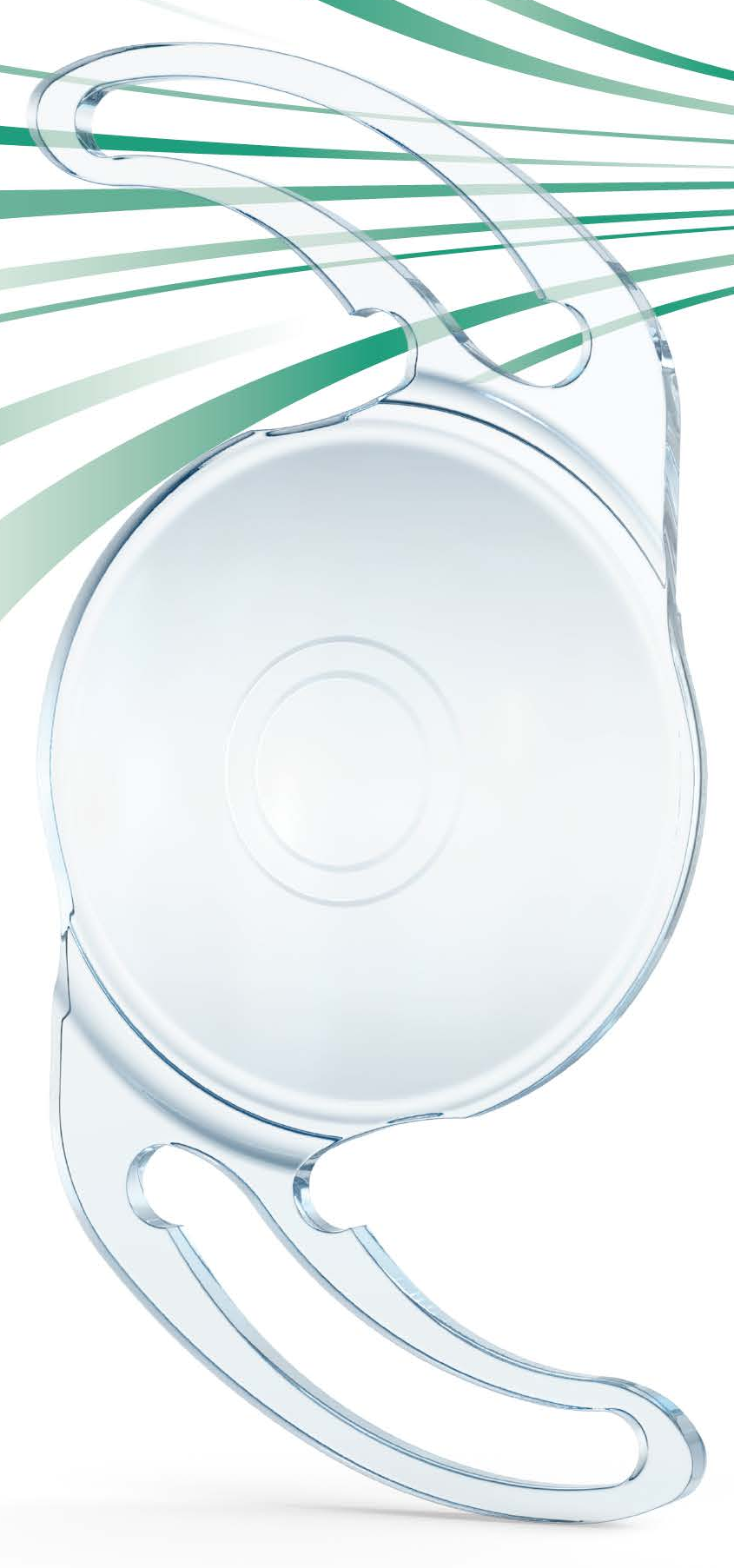
The 877PEY is a hydrophobic acrylic lens with a central optical design that does not use diffractive rings. The toric 877PETY also corrects astigmatism, but results for the non-toric lens must not automatically be presented as a separate toric trial. Non-diffractive describes the construction; it does not mean that halos are impossible.
What the first clinical studies showed
A multicentre study enrolled 38 people; 29 contributed to the main visual-performance analysis. It reported useful distance and intermediate vision, but had no control lens. Medicontur supported the study. Comparing its chart results with numbers from other publications is not the same as operating on comparable patients in a direct randomized trial.
A separate three-month study of 28 people also reported encouraging distance and intermediate results. Reading at 40 cm was more limited. Its simple contrast test does not establish equivalent performance for all detail sizes and lighting conditions.
The useful interpretation is fairly direct: these selected patients generally gained a distance-to-computer range. The studies do not demonstrate that ELON outperforms Vivity, PureSee or every other EDOF lens.
The reading-glasses question has a clear answer
A one-year retrospective study adds an important reality check. In the 12-month questionnaire, 95.2% of respondents still needed near glasses, although they reported independence at distance and intermediate tasks. Needing glasses and wearing them all the time are different questions.
Only 23 patients had 12-month visual measurements, and 21 had paired questionnaires. Four patients with adverse events were excluded from the visual-benefit analysis but retained in the safety analysis. This is informative follow-up, not a precise personal prediction or a comparison against another lens.
Some patients were more satisfied over time, without a broad improvement across all measured vision tests. That is not a guarantee that everyone will adapt or that a persistent problem should simply be ignored.
Fewer bothersome halos is not the same as no halos
In the 28-person study, 59.3% reported no or only occasional halos; 85.2% reported no or slight bother from them. The first asks whether an effect occurs; the second asks how unpleasant it is. Replacing both with 'almost no halos' would lose the meaning.
The multicentre study likewise grouped absent, mild and moderate symptoms together in one headline percentage. A reassuring combined category does not tell you how many people had no symptoms at all. For the differences between rings, glare and starbursts, see this explanation of light effects.
What the evidence does not settle
The published reports are small and do not contain a direct randomized control-lens comparison. One was manufacturer-supported; a one-year paper discloses that an author consulted for Medicontur. Sponsorship does not invalidate results, but it belongs in an honest reading of them.
The studies also used different questions, selected eyes and different amounts of follow-up. A higher near-glasses percentage in one report is not automatically a contradiction of occasional glasses use in another. How to read clinical data explains why the question being asked matters.
Further treatment was sometimes needed; YAG laser opens a cloudy capsule behind an implant. Not every postoperative event can be attributed to the IOL. This review did not identify an exact ELON FDA SSED; it does not infer the approval status of every market from that search.
Where ELON fits in a real decision
ELON is a reasonable lens to discuss when distance and intermediate freedom matter more than avoiding reading glasses completely. Compare that goal with PureSee, Vivity or a full-range lens, using the same everyday tasks rather than advertising labels.
An EDOF label does not decide whether your cornea, tear film, retina or optic nerve can support the proposed result. Nor do a few study participants with other eye conditions prove suitability for everyone with those conditions. The visual-priorities questionnaire organizes your preferences; the clinical examination is a separate step.
- What will I realistically see at my computer and reading distances?
- How likely is reading-glasses use, and what night symptoms should I expect?
- What in my eye examination changes the lens choice or calculation?
Sources and their limits
- Medicontur ELON brochure — manufacturer design and model descriptions, not proof of comparative superiority.
- EDOF classification and multicentre ELON outcomes, 2025 — full text; selected patients, no control lens, manufacturer support.
- Three-month visual outcomes, 2025 — full text; 28 people, no control group, limited contrast assessment.
- One-year outcomes, 2025 — full text; retrospective, unequal follow-up and disclosed consultancy. Near-glasses need must not be confused with frequency of wear.
Educational information—not a diagnosis or medical prescription. An eye-care professional must assess your eyes and medical suitability before treatment or surgery.