ClearView 3 and SBL-3: what lens are we talking about?
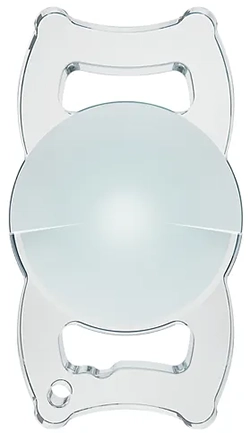
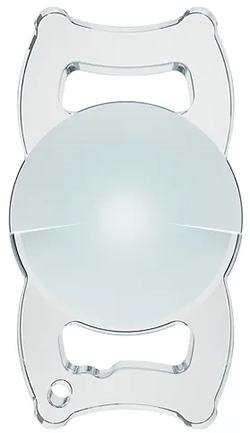
ClearView 3 is the commercial name associated with Lenstec's SBL-3. It is an asymmetric refractive bifocal, not a trifocal simply because there is a '3' in the name. One part of the optic is designed for near vision and another for distance; useful intermediate performance is a clinical question, not a third named focus.
The manufacturer emphasizes a ring-free design and reduced glasses dependence. The implant is hydrophilic HEMA acrylic. Lack of diffractive rings does not establish monofocal-like contrast or freedom from halos. SBL-2 is a different model and must not borrow SBL-3's approval or results.
What the original FDA comparison established
The FDA safety and effectiveness summary describes a randomized comparison with the Akreos AO60 monofocal lens. ClearView 3 improved near vision and met specified distance and intermediate criteria. Those criteria allowed a defined small difference; meeting them is not proof of superiority over every premium lens.
The same evidence describes lower contrast and more light-related symptoms than the monofocal control, including limitations relevant to driving. These are not invented disadvantages for balance. They are part of the actual comparison. Reading small high-contrast letters and detecting a dim object are different visual tasks: contrast sensitivity explains why.
The original US approval concerned selected cataract patients with no more than 1 dioptre of preoperative astigmatism and implantation in the lens capsule. It does not establish suitability for glaucoma, retinal disease or every eye after laser vision correction.
The awkward safety detail deserves to stay visible
The FDA summary reports additional surgical interventions in 12 of 656 implanted SBL-3 eyes: 1.8%, above the historical ISO reference of 0.8%. Six were associated with optical symptoms and six were not. The optical-symptom comparison with the active monofocal control was not statistically significant; that does not prove identical risk.
This is not a reason to call the lens bad. It is a reason to ask which further procedures occurred, what caused them and what the exact patient information says. The FDA also assessed disclosed investigator financial interests rather than pretending they did not exist.
There is now a completed comparison with PanOptix
The completed FDA post-approval study compared ClearView 3 with original PanOptix models, not PanOptix Pro. It enrolled 490 people and assessed six-month safety outcomes.
Most reported comparisons did not show statistically significant differences. However, one primary criterion concerning a change in the eye's measured refraction of at least 1 dioptre between visits was not met. In ordinary language, that concerns stability of the glasses correction over time.
The public summary does not provide the detailed rates or direction needed to quantify that result. It also records a recommendation for a labeling change. We should not turn it into either 'identical to PanOptix' or a guessed percentage of patients harmed. The summary's follow-up percentage is inconsistent with its own fraction; this review does not repeat that percentage.
How much can you rely on these claims?
Randomized FDA-reviewed data are stronger support for the studied near-vision benefit than an optical illustration or an uncontrolled patient series. But the strength belongs to a particular question: benefit against a monofocal does not prove a winner against another full-range lens.
The post-approval comparison supplies important additional safety information, while its public summary leaves numerical questions unresolved. A later extension of available lens powers is not a new trial showing better vision. This review could not verify every latest labeling supplement, so it does not claim to replace the current patient and surgeon instructions.
For the distinction between superiority, non-inferiority and 'no significant difference', see How to read clinical data.
What this changes in your choice
ClearView 3 is a genuine presbyopia-correcting option with regulatory clinical evidence—not just a marketing concept. Its near benefit must be weighed against measured contrast and light-effect differences, and the updated stability finding deserves a specific discussion. A ring-free lens is not automatically a no-compromise lens.
Ask about your reading distance, night driving and willingness to use glasses, then how your eye examination affects that choice. The visual-priorities questionnaire can help you describe those priorities. It cannot decide whether an implant is medically appropriate.
- Which exact ClearView model and current patient instructions apply to me?
- What do the night-vision and updated stability results mean for my tasks?
- How would my eye health and astigmatism change the plan?
Sources and what they establish
- Lenstec ClearView 3 product page — manufacturer claims and implant image, not independent clinical proof.
- FDA P200020 SSED — full regulatory source; randomized monofocal comparison, effectiveness, contrast, symptoms and safety limits.
- FDA completed SBL-3 post-approval study — original PanOptix comparison; the missed stability criterion and limited public detail are retained.
Educational information—not a diagnosis or medical prescription. An eye-care professional must assess your eyes and medical suitability before treatment or surgery.