The short answer
Tear production, distribution and drainage are connected but not identical. Watery eyes can have several causes; the appearance alone does not establish dry eye or tell you which drop to buy. If tearing persists, the eye-care examination should consider both the surface and drainage, rather than assuming that water rules dryness out.
This article explains the system, not a home test. For the first practical step, read burning, grittiness and changing blur.
Water, lipids and mucins: functions, not three rigid shelves
The watery component carries dissolved substances. Lipids contribute to the stable outer surface; mucins help the tears interact with the eye surface. The familiar three-layer drawing is a teaching simplification. Modern descriptions include a mucoaqueous component and surface-associated mucins, not three perfectly separate sheets.
That distinction matters when interpreting product advertising. A slogan about one ‘missing layer’ is not a finding from your examination. Ask the clinician which observed problem a proposed treatment is addressing. You do not need to remember every molecule to ask a useful question.
The eyelids belong in the explanation
Blinking spreads and renews the film. Meibomian glands in the eyelids contribute lipids; the lacrimal system supplies watery tears. Tear drainage is another part of the system. An examination may therefore include the lids and blink, not just a measurement of how wet a paper strip becomes.
The current TFOS DEWS III approach considers several possible drivers, including tear-film deficiencies, eyelid and surface problems and systemic conditions. Mixed problems are possible. A single symptom or a single measurement should not be turned into a complete explanation of your eye.
What does this have to do with sharp vision?
The tear-covered front surface is part of the eye's optics. Its instability can affect the image between blinks. But not every changing image is a tear-film problem, and an apparently good amount of tears does not answer every optical question.
For example, ‘my eyes water when I read’ is useful to report. It is much less useful to conclude ‘I must need lipid drops’ without an assessment. Bring the observation, not a diagnosis you feel obliged to defend.
Questions for a more useful appointment
These questions are not a request for every available device or test. The clinician chooses an appropriate assessment. You are asking for the reasoning behind the plan, not trying to prescribe it.
- Were there signs of an unstable tear film or surface damage, and what else could explain the symptoms?
- Did the examination show an eyelid or blinking problem?
- Is the treatment intended to lubricate, address inflammation, manage the lids or address another cause?
- How will we judge whether it is helping, and what should trigger an earlier review?
Before choosing an artificial lens
A lens placed inside the eye cannot replace the tear film outside it. If cataract surgery is relevant, read why the surface is assessed before the final lens measurements. For decisions about drops and supplements, see practical care and omega-3.
New severe pain, sudden visual loss, a markedly red eye or sudden double vision needs prompt medical help, not a deeper physiology article. Educational detail should not delay care.
Sources and limits
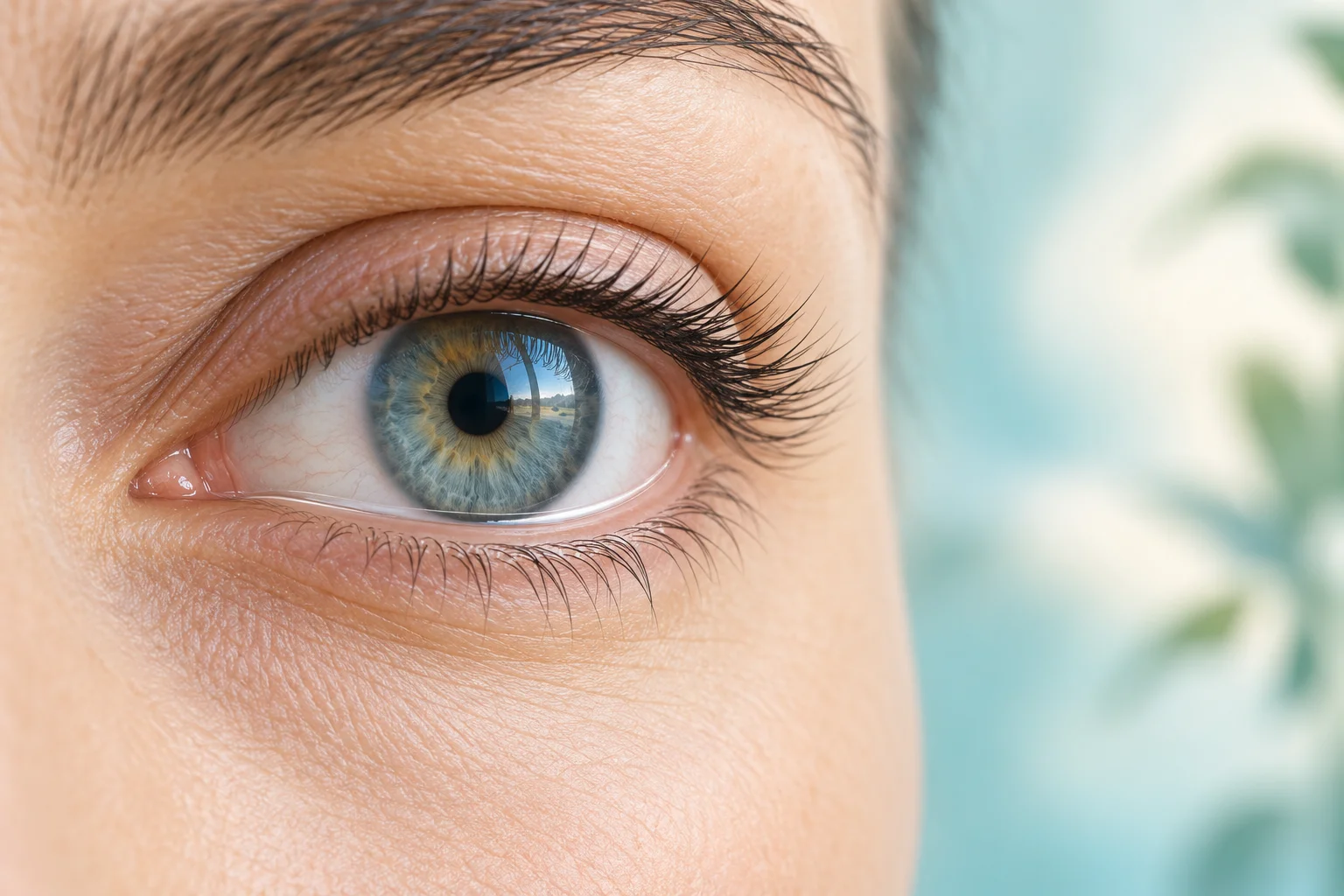
Willcox and colleagues: TFOS DEWS II Tear Film Report (2017); CORE summary of TFOS DEWS III diagnostic methodology (2025); NEI: causes of dry eye. Checked 11 October 2026. The illustration is not anatomical proof or a clinical test.
Educational information—not a diagnosis or medical prescription. An eye-care professional must assess your eyes and medical suitability before treatment or surgery.