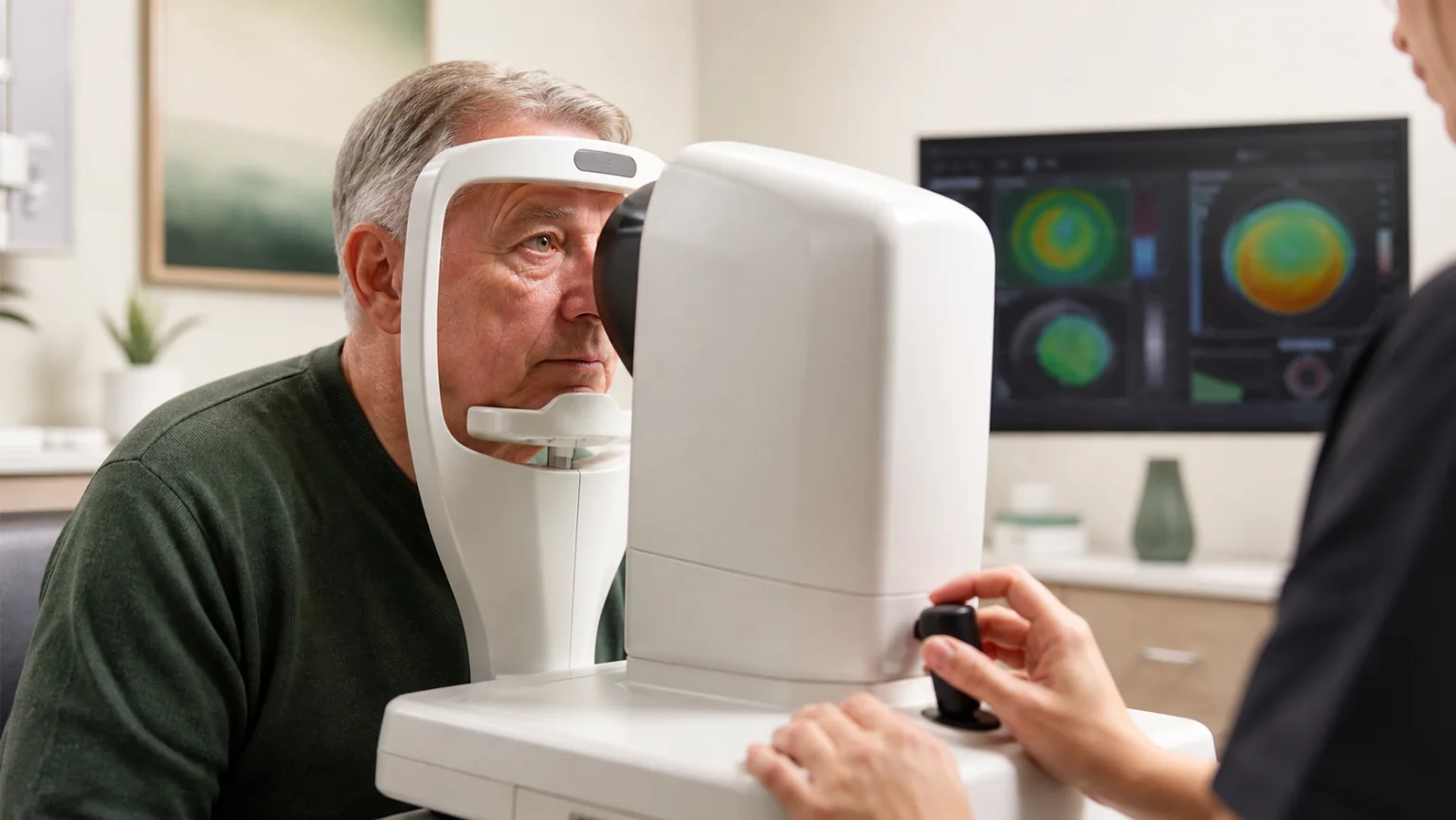
If you had LASIK, PRK or radial keratotomy (RK) years ago, cataract surgery is still possible. Optical planning before surgery needs particular attention. After RK, the old corneal cuts can also affect where the surgeon makes the cataract incision. Previous refractive surgery changed the shape and focusing power of your cornea, so standard measurements and formulas can be less predictable than in an untreated eye.
This does not mean that a multifocal, EDOF or toric IOL is automatically forbidden. It means the decision needs better measurements, realistic expectations and a surgeon experienced with post-refractive eyes.
Why the IOL calculation is harder
Most biometers estimate corneal power from the front surface of the cornea and from assumptions about the relationship between its front and back surfaces. LASIK and PRK change that relationship. RK changes the cornea in a different way through radial incisions and may also produce day-to-day or morning-to-evening fluctuation.
Modern post-refractive formulas, measured total corneal power and the ASCRS post-refractive calculator improve accuracy. Even so, studies consistently show that results remain more variable than in eyes with no previous corneal surgery. A small residual prescription is therefore more likely, even when surgery and measurement were performed carefully.
Bring your old records if you have them
Tell the clinic exactly which procedure you had and whether it treated nearsightedness, farsightedness or astigmatism. Bring old glasses prescriptions, corneal measurements or maps, and the original procedure report if available. Modern calculation methods can still be used when those records are missing. The team needs to check the current corneal shape, the tear film and whether measurements are repeatable; corneal topography or tomography maps and repeated biometry help answer those questions.
Which IOL type can be considered?
Monofocal lenses usually place the fewest additional demands on optical quality. They do not eliminate the calculation challenge, but they are often the most forgiving when the cornea is irregular or night-vision quality is the priority.
Toric lenses may be appropriate when astigmatism is regular and measurements are stable. A toric IOL cannot correct irregular corneal optics, and an unstable tear film can make the measured amount or axis of astigmatism unreliable.
EDOF or multifocal/trifocal lenses are not decided by the words “previous LASIK” alone. The surgeon needs to consider corneal regularity, higher-order aberrations, pupil size, retinal and optic-nerve health, night-driving needs and your tolerance for glasses. A lens that splits or extends focus cannot repair poor-quality information arriving from an irregular cornea.
Adjustable strategies, including a Light Adjustable Lens where available, may offer another way to manage uncertainty in the final refractive result. It is still important to understand the lens category and the work required after surgery. Read the evidence-aware LAL explainer.
Questions worth asking your surgeon
- Are my corneal measurements repeatable enough to plan the lens?
- Which lens design is reasonable for my cornea, and how likely am I to need glasses?
- If the result misses our target, what correction options would be reasonable for my eye?
The practical conclusion
After LASIK, PRK or RK, the safest question is not “Which premium lens is best?” It is “How predictable are my measurements, what optical quality does my cornea provide, and which trade-off fits my life?” A careful plan can produce an excellent result, but no responsible consultation should promise perfect refractive accuracy.
Editorial addition: IOL Adviser · 10 October 2026
What if my old LASIK records are missing?
Missing records do not automatically prevent cataract planning. They also do not make the previous surgery irrelevant. Tell the clinic what you know before the measurements, including whether the old operation was LASIK, PRK or RK. If you are unsure, say so rather than filling in the gaps from memory.
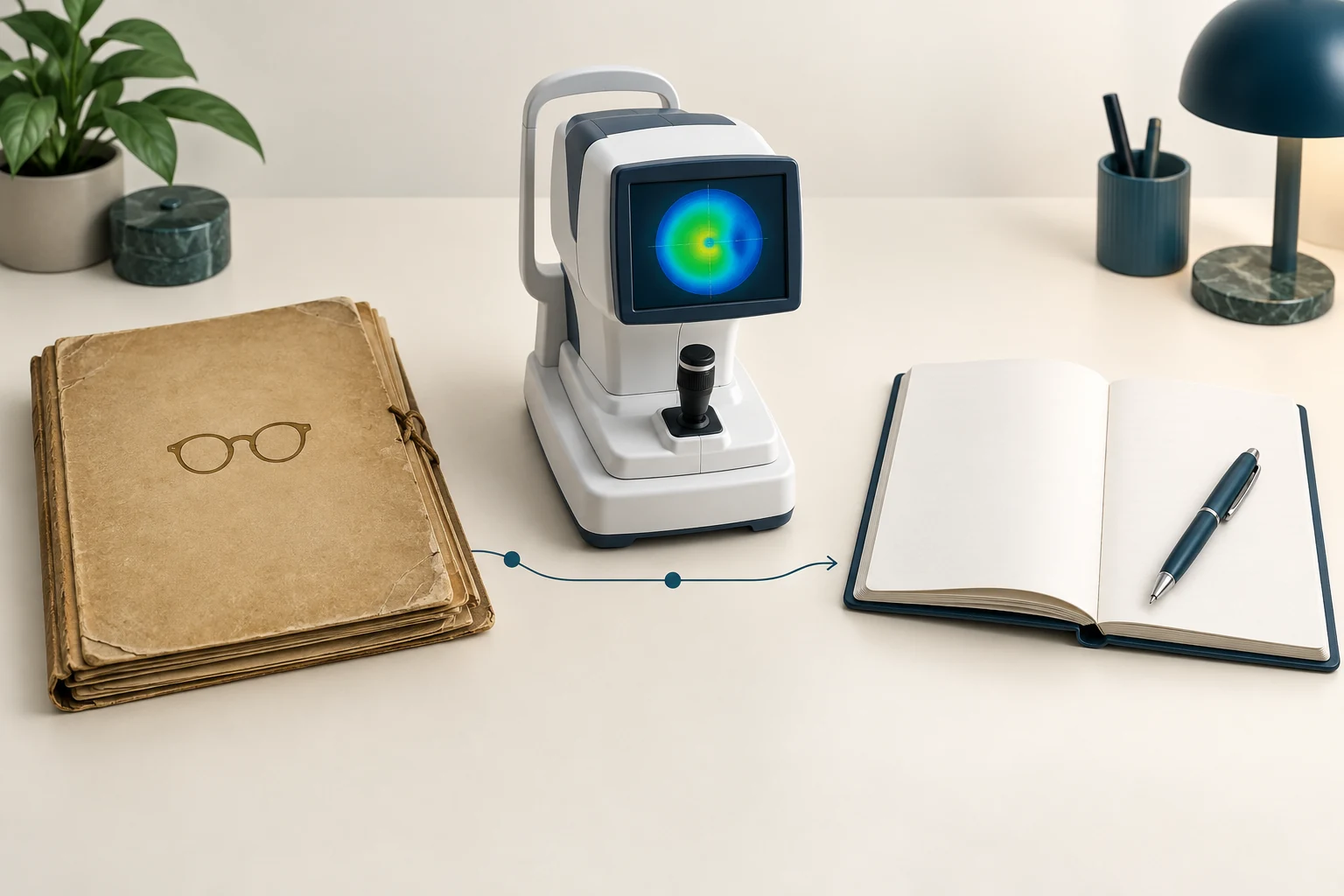
Request the useful documents, not a guessed prescription
Ask the original clinic for the procedure report and any available measurements or prescriptions from before and after the operation. Check that each document has a date and identifies the correct eye. A prescription from years later is not necessarily the prescription used before the original surgery.
Keep missing information marked as missing. Do not copy an approximate number into a worksheet as if it were a clinical record. You can still describe practical facts you remember—such as wearing distance glasses before the operation—while making clear that they are recollections.
Today's measurements are not an optional replacement for the paperwork
The cataract team still needs to examine and measure the present eye, including the corneal shape. Old numbers cannot establish today's surface regularity or decide whether a particular implant is suitable. ESCRS recommendations address current corneal assessment and dedicated calculations after previous refractive surgery.
Ask whether the clinic has enough current information to plan responsibly without the missing records, or whether another examination is needed. That question is more useful than requesting a particular formula from a calculator you found online.
“No history” is a calculation approach, not “no uncertainty”
Researchers have studied calculations that do not require the old refractive-surgery measurements. In one study, most of the 49 people had no such historical data available. It studied 64 eyes after myopic LASIK or PRK, not a group of RK eyes. The results therefore should not be treated as proof for every previous procedure. Yeo and colleagues.
The useful conclusion is narrower: there are ways to plan when records cannot be recovered. It is not a guarantee of an exact glasses prescription or a reason to skip current examination. Ask the surgeon to explain the uncertainty that remains in your own case.
At the appointment, separate three things in your notes: documented history, facts you remember, and questions still unanswered. The clinic can then see what it can verify instead of having to disentangle confident-looking but uncertain numbers.
Sources and evidence
Sources support the medical statements. The interpretation and plain-language explanations are Oleksii Sologub's.
- ESCRS Guideline for Cataract Surgery — IOL calculations after refractive surgery
- Savage & Pantanelli: updated review of IOL calculations after laser refractive surgery
- Network meta-analysis: IOL calculations after myopic laser surgery and radial keratotomy
- Review: biometry and IOL calculation after laser vision correction