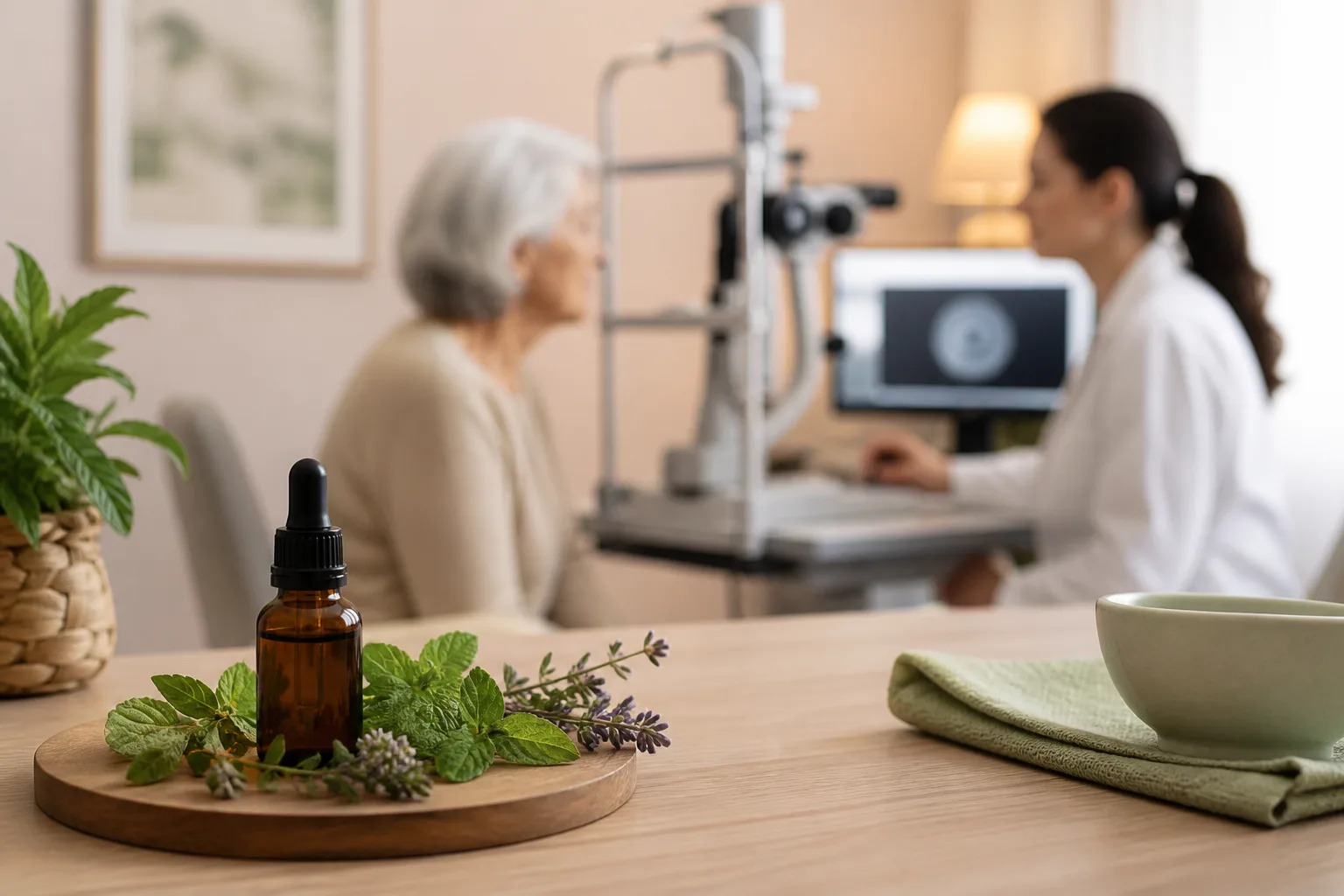
It's easy to find articles and videos online about miracle decoctions, honey drops in the eyes, references to well-known "alternative method" authors — and, most convincingly, real comments from people who claim it helped them. Let's go through this honestly: what actually works, where these testimonials come from, and why something that looks like personal experience is often misleading.
Do not put non-sterile homemade mixtures, including honey, into your eyes. Discuss eye-drop use with your ophthalmologist. FDA explains why eye products must be sterile.
Why glaucoma is especially easy to "cure" with a folk remedy — on paper
Glaucoma is a group of diseases that damage the optic nerve. Eye pressure is an important risk factor, but glaucoma is not defined only by a high pressure reading. The common open-angle form often has no obvious early symptoms, so feeling “no worse” after a remedy does not show that the disease is controlled. Monitoring requires professional examinations that may include pressure, optic-nerve imaging and visual-field testing.
So where do "it helped me" testimonials actually come from?
Many testimonials are sincere. The problem is not necessarily dishonesty; it is that an individual cannot observe the untreated version of the same eye at the same time. Symptoms can fluctuate, expectations change perception, and glaucoma may progress without symptoms. A personal story can generate a research question, but it cannot establish that a remedy caused the outcome.
Causation is not the same as timing
If vision seems better the day after using “special drops,” two events happened in sequence. That alone does not show that the drops caused the change. Vision can fluctuate because of the tear film, lighting, pupil size, refraction, retinal or neurological factors and the way the test was performed.
To establish causation, we need to compare similar people who did and did not receive the treatment while reducing the other explanations. One person's before-and-after impression cannot do that.
How medicine actually verifies what works
To test whether treatment helps, researchers compare similar groups and measure their outcomes. Random allocation and blinding can reduce bias when feasible. The comparison may be standard treatment, not only an inactive placebo. No single trial design or fixed number of hundreds of participants fits every question. NIH explains how these study methods work.
In everyday life, one person does not provide that control group. The improvement might have happened without the drops.
The psychological trap: survivorship bias
The success stories we see may be a selected sample: people who tried the same remedy without improvement may never post a comment. This is survivorship bias. Without knowing how many people tried it and what happened to all of them, even many sincere positive comments cannot establish a success rate.
What evidence-based medicine actually says about cataracts and glaucoma specifically
No eye drop, exercise, supplement or folk remedy has been shown to remove or reverse a cataract; surgery is the only way to remove the cloudy lens. Glaucoma is different: proven treatment can include prescription drops, laser and surgery, selected according to glaucoma type and risk. These treatments aim to lower risk and slow further damage; they do not restore optic-nerve tissue already lost.
Reasonable skepticism isn't the same as blind trust in doctors
An important note: this isn't a call to ignore real problems in the healthcare system — doctors not having enough time to explain things, commercial interests at some clinics, varying levels of expertise. That's a separate, legitimate topic. But distrust of a specific doctor or clinic isn't an argument in favor of unproven remedies. If you're unsure about a recommendation, seek a second professional opinion — not an alternative without proven effectiveness.
Practical takeaways
- A testimonial cannot distinguish treatment effect from coincidence or natural fluctuation.
- Open-angle glaucoma can progress without obvious symptoms, so objective follow-up matters.
- Folk remedies have not been shown to reverse cataracts or control glaucoma.
- Cataract surgery timing should be discussed from benefits, risks and daily-life impact — not fear or urgency marketing.
- If you distrust one recommendation, seek a qualified second opinion without stopping prescribed glaucoma treatment on your own.
Sources and evidence
Sources support the medical and technical statements. Interpretation and plain-language explanations are Oleksii Sologub's.