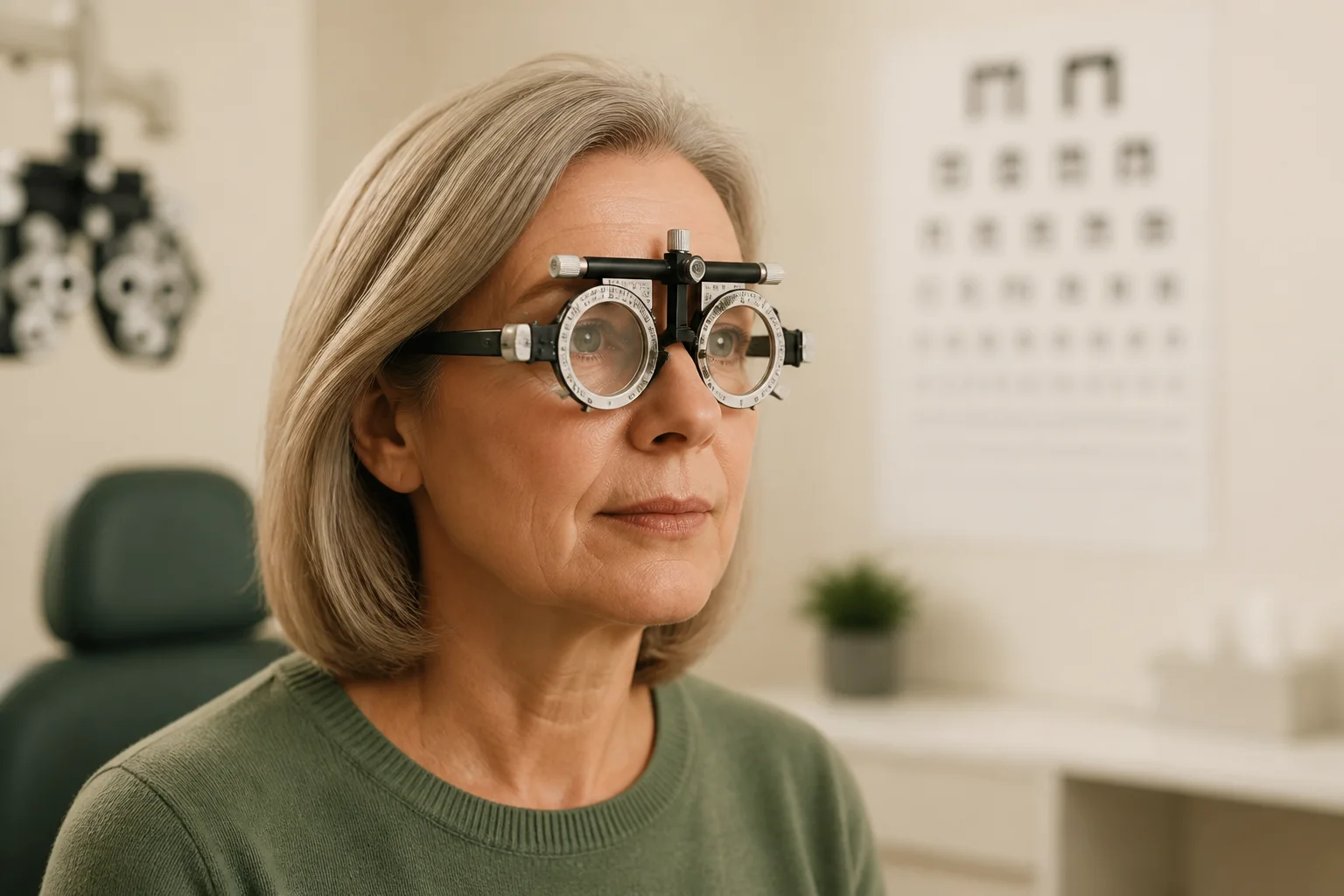
Why does someone wearing glasses with a perfectly measured prescription sometimes still not see 100%? Do glasses actually "ruin your eyesight," as some patients fear? And why do exercises or vitamins not correct ordinary refractive blur, despite common marketing claims? These three questions are actually connected by the same fact about how vision really works — and understanding that fact is the key before drawing any conclusions about why glasses "aren't helping" you.
The optics and the image sensor both have to work
Think of the eye as an optical system with a sensor. The cornea and crystalline lens focus light; the retina receives it and converts it into neural signals. Those signals then travel through the optic nerve and are processed by the brain. Like every simple model, the camera comparison stops there: living retinal and neural tissue is not a digital device.
This is why a clear optical image is necessary but not always sufficient for normal visual acuity. Refraction can correct optical blur; it cannot repair a biological limit in the retina, optic nerve or visual pathway.
What glasses actually can fix: refractive errors
Glasses and contact lenses bend light so it focuses more accurately on the retina. They correct refractive errors such as myopia, hyperopia and astigmatism; they do not repair retinal cells, the optic nerve or the visual cortex. Laser refractive surgery and an intraocular lens also change optical focusing, but each has its own indications and risks. A careful refraction answers one question: how much of the blur is optical?
The myth that scares people the most: "glasses ruin your eyesight"
Ordinary prescription glasses do not make eyes weaker or worsen vision; the National Eye Institute states that they make vision clearer while worn without changing the eye itself. Presbyopia continues with age whether or not reading glasses are used. Childhood myopia needs more nuance: standard correction does not “cause” progression, but leaving a child undercorrected is not a treatment and may slightly worsen progression. Some specially designed spectacle or contact lenses and medicines can slow progression in selected children, so pediatric myopia deserves professional follow-up rather than deliberate blur.
What about eye exercises and vitamins?
Exercises do not change axial eye length, corneal shape or a cataract, so they do not remove ordinary refractive error. Vitamins do not sharpen vision when a nutrient deficiency or specific retinal indication is absent. There are important exceptions to the broad phrase “eye exercises do nothing”: clinicians use targeted therapy for problems such as convergence insufficiency, and perceptual-learning research addresses visual processing rather than refraction. The right question is what diagnosis a proposed treatment is actually intended to treat.
When the limit isn't in the optics — it's somewhere else
If best-corrected vision remains reduced, the next step is not stronger glasses by default. Possible causes include cataract or corneal irregularity, retinal disease, optic-nerve damage, amblyopia and other neurological or ocular conditions. A dilated eye examination and, when indicated, imaging or visual-field testing help locate the limit. Sudden or rapidly worsening loss of vision needs urgent medical assessment.
Amblyopia: when the brain never learned to "develop" a sharp picture
Amblyopia is a developmental reduction in best-corrected vision, usually in one eye, caused by abnormal visual experience early in life — commonly unequal prescriptions between the eyes, strabismus or visual deprivation such as childhood cataract. The eye may look structurally normal, yet the visual system has learned to favor the other eye. Early detection is important, but age 7 is not a hard biological deadline: randomized evidence shows that some children and teenagers aged 7–17 can still improve with appropriate correction and selected treatment.
There's hope for adults too — but not through ordinary "exercises"
Treatment is usually less effective in adults than in children, but adult visual plasticity is an active research area. A 2025 systematic review of perceptual-learning and video-game training found average improvement across adult studies, while protocols and individual results varied. The FDA cleared the prescription AA-1 computerized vision-treatment system for amblyopia in patients aged 9 years or older (K012530). That clearance is for amblyopia; it is not proof that the same program treats every retinal disease, nystagmus or unexplained loss of vision. Diagnosis and supervision by an eye-care professional remain essential.
Practical takeaways
- Glasses correct focus; they cannot repair every retinal, optic-nerve or visual-processing problem.
- Wearing ordinary prescription glasses does not make eyes weaker.
- Children with progressive myopia should not be deliberately undercorrected as a home strategy; ask about evidence-based myopia control.
- If best-corrected vision remains reduced, the reason needs an eye examination rather than stronger lenses alone.
- Amblyopia develops from abnormal visual experience early in life and is easiest to treat when found early, but improvement beyond early childhood can still occur.
- Computerized perceptual training has evidence and a specific FDA-cleared amblyopia indication, but it is not a universal cure for poor vision.
Sources and evidence
Sources support the medical and technical statements. Interpretation and plain-language explanations are Oleksii Sologub's.
- National Eye Institute: eyeglasses for refractive errors
- National Eye Institute: amblyopia (lazy eye)
- Myopia-control interventions in children: living systematic review
- Perceptual learning and video-game training for adults with amblyopia: systematic review
- FDA 510(k) K012530: computerized treatment for amblyopia age 9 and older